
On September 28, 2026, Shopify announced that it is expanding its Web Model Context Protocol (WebMCP) integration directly into its checkout architecture, enabling browser-based artificial intelligence agents to modify cart details and complete end-to-end purchases on behalf of buyers. The update closes the final loop in agentic commerce, transforming automated shopping from passive product research into active, authenticated transactions without requiring custom code or merchant setup.
Until now, autonomous agents operating in consumer web browsers could search product catalogs, manage shopping carts, and navigate users to a storefront checkout page, but they were forced to stop at the payment threshold. By extending WebMCP into checkout-web—Shopify’s unified, cloud-hosted checkout frontend—AI assistants can now handle the mundane tasks of populating customer data, applying promotional discounts, and submitting final orders, provided the human shopper grants explicit authorization.
Bridging the Last Mile of Agentic Shopping
The move marks a decisive milestone for Shopify’s long-standing push into machine-mediated commerce. Over the past two years, artificial intelligence platforms have steadily evolved from conversational chatbots into autonomous digital assistants capable of executing multi-step workflows. However, the checkout funnel has historically remained a technical brick wall for autonomous software.
Traditional browser automations often rely on "computer vision" models or brittle DOM scraping scripts to locate buttons, fill out text boxes, and simulate clicks. These methods frequently fail when responsive layouts shift, CSS classes change, or dynamic anti-bot protections fire.
By contrast, Shopify's implementation uses WebMCP—an emerging web standard co-developed alongside engineers from Google and Microsoft—to give browser agents direct, structured entry points into the checkout session. Instead of guessing where the "Submit Order" button is located, an AI assistant queries the browser directly for supported checkout actions and executes them through standardized function calls.
The WebMCP Checkout Toolkit: Four Crucial Commands
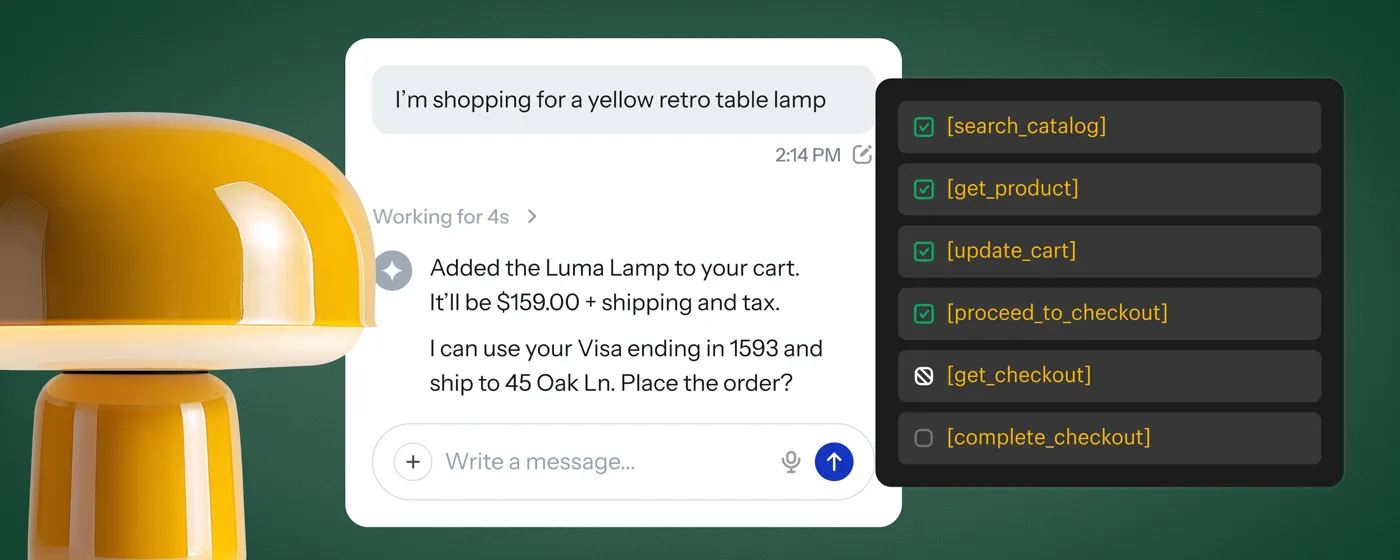 Photo: TechCrunch (source)
The newly released checkout support introduces four specialized WebMCP tools that run directly inside the shopper's active tab. These tools build upon the initial set of ten storefront and catalog capabilities Shopify deployed across Liquid storefronts in August 2026.
| Tool Name | Scope | Primary Function |
|---|---|---|
navigate_to_storefront | Navigation | Returns the shopper from the checkout page back to the merchant's main catalog or storefront. |
get_checkout | Data Retrieval | Reads current checkout state, validation errors, applied taxes, delivery estimates, and post-completion receipts. |
update_checkout | Cart & Buyer State | Programmatically updates supported fields, including shipping addresses, contact details, and discount codes. |
complete_checkout | Transaction | Submits the final order, but strictly after obtaining affirmative confirmation from the buyer. |
Because these tools bind directly to checkout state rather than a separate external API, the shopper sees every modification in real time on their screen. If an assistant updates a shipping address or adds a coupon code, the web interface updates immediately, eliminating invisible background actions.
How WebMCP Works: Moving Beyond Brittle Screen Scraping
To understand why this launch matters, one must look at how WebMCP fundamentally rethinks website interactions. In standard API development, an engineer builds an app that connects to a merchant's server using dedicated API keys, webhooks, and complex authentication flows. This works well for business-to-business integrations, but it does not fit an everyday shopper browsing the web with an AI sidekick.
WebMCP acts as an in-browser interpreter. When a buyer visits a Shopify-powered store using a compatible browser, the webpage automatically registers its callable tools into the browser environment. The buyer's AI agent can inspect that tool registry, recognize what actions are permitted, and pass structured JSON data directly to the site.
Shopify has confirmed that the checkout tools do not expose a new public API, nor do they require store owners to write code or install custom apps. The integration runs inside Shopify’s core checkout engine, automatically available across millions of independent merchants running standard Liquid themes or Hydrogen developer preview headless builds.
Built-In Guardrails: Human Confirmation and Security Escalations
 Photo: shopify.dev (source)
Granting an autonomous program access to financial payment flows naturally introduces security and consumer safety risks. Shopify has incorporated explicit fail-safes and escalation handoffs into the protocol.
- Mandatory Buyer Authorization: The
complete_checkouttool cannot unilaterally trigger a financial debit; it requires affirmative verification from the buyer before the payload is dispatched. - 3D Secure and Biometric Handoffs: If a payment gateway requires two-factor authentication, such as a 3D Secure one-time passcode or fingerprint confirmation, the WebMCP tools immediately yield execution and return full control to the human user.
- Blocking UI Extensions: If a merchant’s checkout flow includes mandatory custom UI elements—such as age verification checkboxes, custom gift messages, or delivery instructions—the tools halt and prompt the shopper to interact directly.
- Session Containment: Tools operate purely within the user's active, authenticated session, ensuring that agents cannot harvest stored credentials or hijack administrative controls.
These safeguards ensure that AI functions as a digital co-pilot rather than an unchecked proxy with a blank check.
Platform Wars: Shopify's Open Ecosystem vs. Amazon's Wall
Shopify’s open stance on agentic checkout stands in sharp contrast to moves made by rival ecommerce giants. Just one week prior to this announcement, Amazon made headlines by aggressively blocking Meta’s new AI assistant, Muse, from operating on Amazon.com, citing concerns over bot crawling, terms of service violations, and credential handling.
Shopify took the exact opposite path. Shopify CEO Tobi Lütke quickly announced native Shop Pay agentic checkout integration for Muse, and Google has rolled out direct Universal Commerce Protocol (UCP) checkout integrations across Google Search AI Mode and Gemini for eligible Shopify sellers.
By leaning into open browser standards like WebMCP and transactional frameworks like UCP, Shopify is positioning its merchant network as the default commerce layer for the artificial intelligence era. If an AI model needs to find an item, price-check it, and purchase it cleanly without hitting scraping barriers, Shopify wants its storefronts to be the smoothest path of least resistance.
Economic and Performance Impact: Why Structured Tools Beat Scraping
 Photo: dokumen.pub (source)
Early performance metrics indicate that machine-readable browser protocols dramatically improve transaction reliability and operating costs. In a case study published by PayPal evaluating WebMCP checkout flows, structured agent tool calls reduced AI model inference costs by roughly 4.6 times compared to screenshot-and-click automations.
Median transaction completion times were cut in half, largely because an agent can execute three structured tool calls instead of stepping through more than 30 interface-interaction prompts. For retailers, faster checkout times correlate directly with reduced abandoned carts, particularly when buyers are multi-tasking alongside an AI assistant.
What Merchants and Consumers Need to Know
For independent merchants, the immediate takeaway is straightforward: check your product and policy hygiene. Because AI assistants query product information, sizing variants, return windows, and shipping terms directly via tools like get_product and search_shop_policies_and_faqs, stores with clean, unambiguous structured data will convert significantly better than those with contradictory policies or missing product attributes. Merchants running heavily customized, headless architectures should ensure their frontends remain aligned with Shopify’s Hydrogen developer previews to take full advantage of the tool bindings.
For online shoppers, using these capabilities currently requires a compatible browser environment. WebMCP is currently undergoing an origin trial in Chromium-based browsers (such as Google Chrome), with desktop environments like OpenAI’s ChatGPT desktop client and Google Gemini experimenting with tool execution. While widespread native mobile browser support is still developing, the protocol lays the foundation for unified, conversational shopping where buyers simply dictate what they need and approve the final total.
The Road Ahead: Browser Standards and Adoption Roadblocks
While the technology is moving quickly, substantial hurdles remain before agentic checkout becomes the mainstream norm. Consumer trust is the largest obstacle. Survey data from Checkout.com and Forrester published in 2026 revealed that while 89% of enterprise merchants are actively building for agentic commerce, only about 3% of consumer transactions involve AI agents, with nearly three-quarters of consumers still hesitant to delegate automated spending.
Furthermore, WebMCP remains a proposed community specification under the World Wide Web Consortium (W3C) Web Machine Learning Community Group. While Google and Microsoft are driving its implementation, neither Apple (WebKit/Safari) nor Mozilla (Firefox) has officially shipped production support. Until WebMCP achieves universal browser parity, agentic checkout will remain predominantly concentrated within Chromium ecosystems and specialized AI desktop clients.
Nevertheless, with checkout now officially wired into the browser toolset, the architecture for autonomous shopping is no longer theoretical—it is actively taking orders.
FAQ
Can an AI agent buy products on Shopify without my permission? No. The complete_checkout tool strictly requires affirmative buyer confirmation before an order can be submitted, and any two-factor security prompts (such as 3D Secure) immediately return control to the shopper.
Do Shopify store owners need to pay extra or install an app to enable this? No, there is nothing to install or configure. The WebMCP checkout capabilities run directly within Shopify's standard checkout-web engine across all Liquid storefronts and Hydrogen developer previews.
Which browsers currently support WebMCP tools? WebMCP is currently available primarily in Chromium-based browsers via an origin trial, alongside early developer integrations in AI desktop apps such as ChatGPT and Google experimental tools. Apple's Safari and Mozilla Firefox have not yet released production support.
How is WebMCP different from traditional web scraping? Instead of an AI model taking screenshots, reading messy HTML code, and simulating mouse clicks, WebMCP lets the website explicitly register structured functions that the AI can call cleanly and instantly by name.
Can merchants turn WebMCP checkout off? While Shopify's checkout tools run natively out of the box, merchants managing custom headless Hydrogen stores have developer-level controls, and sellers can manage general agentic discovery and third-party channel connections inside the Shopify Admin settings.