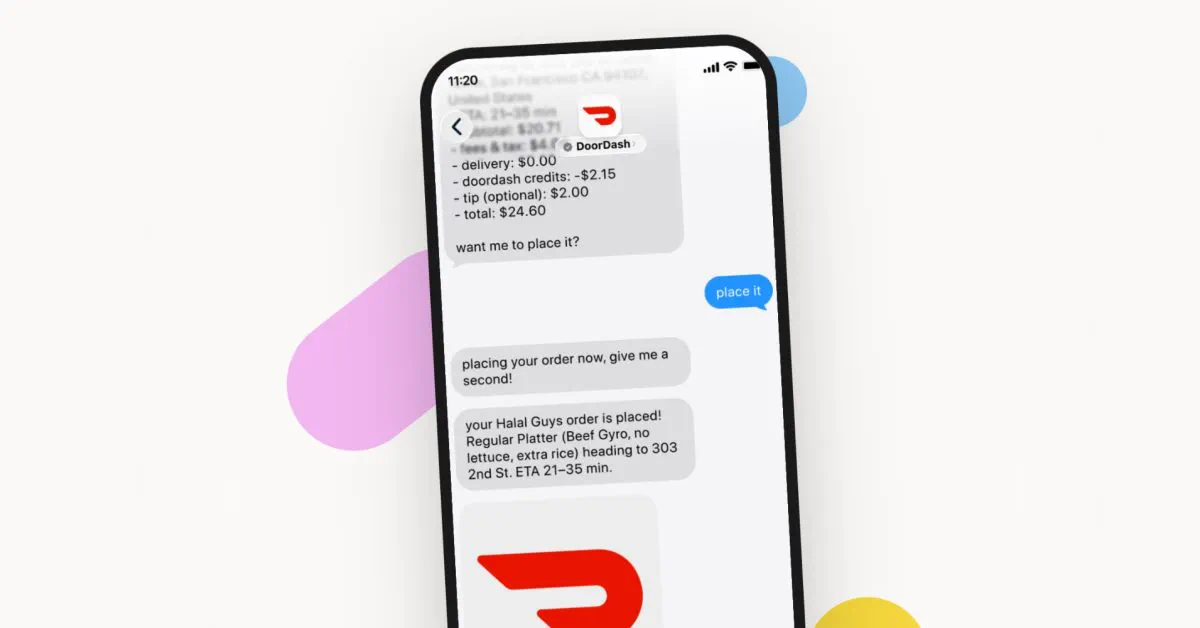
DoorDash announced on Wednesday that iPhone users in the United States can now place food and grocery orders directly through Apple’s Messages app. Unveiled during the company’s Dash Forward 2026 event in San Francisco, the conversational AI agent lets customers text meal requests, review photo recommendations, and check out seamlessly within a standard message thread.
The move marks a significant evolution in conversational commerce, shifting DoorDash from a standalone marketplace app into everyday messaging interfaces. By embedding an autonomous AI ordering agent inside Apple Messages, DoorDash aims to eliminate browsing friction, simplify group orders, and capture immediate cravings through conversational texting.
What DoorDash Announced at Dash Forward 2026
At its annual Dash Forward showcase, DoorDash revealed an array of platform updates led by conversational commerce. Chief among them is an AI agent running inside Apple Messages that handles the end-to-end purchasing workflow. Instead of tapping through storefronts, adding modifiers manually, and navigating digital shopping carts, consumers can chat with the delivery service as if texting a personal shopper.
The feature operates as an extension of "Ask DoorDash," the conversational tool the company piloted inside its mobile app earlier in the year. However, shifting the interface entirely into Apple Messages allows users to bypass opening the DoorDash application altogether. The agent parses complex natural language instructions, interfaces directly with local merchant inventory, compiles the order, and handles native checkout inside the text thread.
Access to the text-based service opened on Wednesday via a waitlist for iOS users located in the United States. DoorDash confirmed that rollouts will proceed gradually before expanding to wider consumer groups.
How Text-to-Order Works: Features, Capabilities, and Mechanics
 Photo: 9to5mac.com (source)
The text-ordering agent is designed around natural conversation rather than rigid menu prompts. Once connected, the user interacts with DoorDash using everyday language.
Key features included in the Apple Messages integration include:
- Craving-based search: Users can text open-ended requests such as "Find spicy noodles nearby" or "Order a filling family dinner," and the agent queries local restaurants to present tailored options.
- Rich media recommendations: To prevent blind ordering, the AI pulls dish photography directly from merchant storefronts and delivers pictures inside the chat thread alongside prices and item descriptions.
- "Order my usual" recall: The AI retains contextual awareness of user history. Sending "order my usual" triggers the system to identify typical Friday night dining habits, exact ingredient exclusions (like omitting cilantro), and preferred add-ons without requiring manual re-entry.
- Proactive habit prompts: If enabled, the agent can proactively text a customer to ask whether they want their regular weekday morning coffee or routine grocery essentials restocked based on historic ordering patterns.
- Multi-preference group ordering: The bot is built to parse group requests with competing requirements, aggregating dishes for gluten-free, vegan, or allergy-sensitive diners into a unified checkout.
- Frictionless in-thread checkout: Confirmation of total costs, tips, taxes, and delivery windows occurs right inside the thread, completing payment with saved account details.
| Feature | Traditional DoorDash App | Ask DoorDash (In-App) | Apple Messages AI Agent |
|---|---|---|---|
| Platform Access | iOS, Android, Web | DoorDash iOS App | Apple Messages (iOS) |
| Input Method | Manual taps and search bars | Text prompts, photos, voice | Natural conversational text |
| Search Logic | Exact restaurant or food match | Conversational intent & mood | Contextual intent & habit memory |
| Visual Output | Grid listings | Interactive chatbot cards | Rich photo embeds in SMS/iMessage |
| Group Management | Group cart sharing links | In-app recommendations | Multi-preference text parsing |
| Checkout Step | Native app checkout page | In-app checkout | In-thread conversational confirmation |
| Availability | General release (Global) | Select U.S. markets | U.S. waitlist (iOS only) |
The Background: From Search Filters to Generative Agents
DoorDash’s integration with Apple Messages is the latest step in a multi-year effort to modernize how consumers find goods across its network. The company facilitates billions of lifetime orders and manages an inventory spanning more than 800,000 menu items and retail products per average metro area. As catalog density expanded into supermarkets, pet care, apparel, and hardware, standard search bars began exhibiting discovery fatigue.
In late 2024, DoorDash integrated with Apple’s Reminders app, allowing users to import grocery checklists directly into delivery carts. Earlier in 2026, the company launched the internal "Ask DoorDash" interface, pulling models developed by OpenAI, Anthropic, and Google alongside open-source engines. Internal metrics revealed that early AI chatbot users assembled grocery carts 35% higher in average value and checked out five times faster than manual shoppers, while roughly 50% of dining orders went to merchants the consumer had never tried before.
Bringing that engine to Apple Messages removes the biggest hurdle remaining in e-commerce: forcing a shopper to open, update, and navigate an app. By plugging directly into the primary communication tool on the iPhone, DoorDash embeds delivery utility straight into everyday social threads.
How DoorDash Compares to Competitors in Conversational Retail
DoorDash is not alone in turning to generative software to drive basket sizes, but its approach contrasts sharply with peers in delivery and retail logistics.
Instacart has leaned heavily on conversational recipe generation inside its own platform and within OpenAI’s ecosystem, positioning its tools toward kitchen meal-prep workflows. Uber Eats has tested conversational discovery within its core app, guiding consumers toward discounts and merchant recommendations through structured conversational tabs. DoorDash, however, is one of the first major on-demand delivery platforms to shift the entire interaction out of its native app and into Apple’s system-level messaging environment.
This shift removes user onboarding barriers. Instead of relying on push notifications that users frequently silence, an SMS or iMessage thread provides persistent visibility. The integration mimics the ease of texting a personal assistant, granting DoorDash an advantage in transaction speed and convenience.
Industry and Community Reaction
The launch drew praise from tech analysts who view AI agents as the next evolution beyond static app icons. Industry watchers noted that conversational interfaces are moving from gimmicky chatbots to practical transactional utilities. Placing an order by typing four words—like "send the usual sushi"—demonstrates tangible consumer value that raw model benchmarks rarely convey.
However, early community reactions among privacy advocates and consumers have raised practical questions. Messaging agents require access to extensive historical preferences, delivery locations, and automated payment authorizations to function as advertised. Some diners have expressed concern over unintended orders or misheard custom instructions, particularly when dealing with severe food allergies or expensive specialty items.
What This Means for Users and Practical Advice
For iPhone owners eager to try text ordering, the utility lies in convenience for recurring routines. To make the most of the feature once admitted from the waitlist:
- Keep your DoorDash profile updated: The AI agent relies on default payment methods, saved addresses, and historical preferences. Make sure delivery notes (such as gate codes or apartment drop-off preferences) are accurate in your main account.
- Specify strict allergies explicitly: While the AI is trained to respect historical food exclusions, users should continue confirming that dietary restrictions are explicitly reflected in the order summary text before approving payment.
- Audit proactive notifications: If you prefer not to receive automated prompts asking if you want afternoon coffee or weekend groceries, review notification preferences during the onboarding setup.
What Comes Next and Unanswered Questions
DoorDash’s text-ordering capability is currently limited to iOS users in the United States who sign up for the waitlist. The company has not yet announced an official timetable for a general public release or whether a comparable Rich Communication Services (RCS) or WhatsApp interface will launch for Android users.
Broader enterprise questions also remain. DoorDash has signaled interest in licensing its underlying AI ordering tools to external restaurant and grocery partners under white-label programs. If successful, consumer interactions with local bakeries, regional grocers, and national franchises may soon happen entirely inside conversational messaging windows, reshaping mobile commerce across the board.
FAQ
Do I need the DoorDash app installed to order via Apple Messages? You must have an active DoorDash account with saved billing and delivery details, but once enrolled in the text feature, you do not need to open the DoorDash application to browse menus or place orders.
How do I get access to DoorDash text ordering? The feature is currently waitlist-only for iPhone users in the United States. Customers can sign up through DoorDash's website or the announcement portal.
Can Android users use text-based DoorDash ordering? No, the service is currently exclusive to Apple Messages on iOS during its initial waitlist phase. DoorDash has not confirmed whether an RCS or SMS version will expand to Android.
Can the AI handle dietary restrictions and allergy modifications? Yes, the AI agent is programmed to recognize preferences such as ingredient removals, dietary limits, and group food preferences across complex orders.
Is there an extra fee to order through Apple Messages? DoorDash has not introduced any added surcharge specifically for ordering over text; standard menu pricing, delivery fees, service fees, and tips still apply.