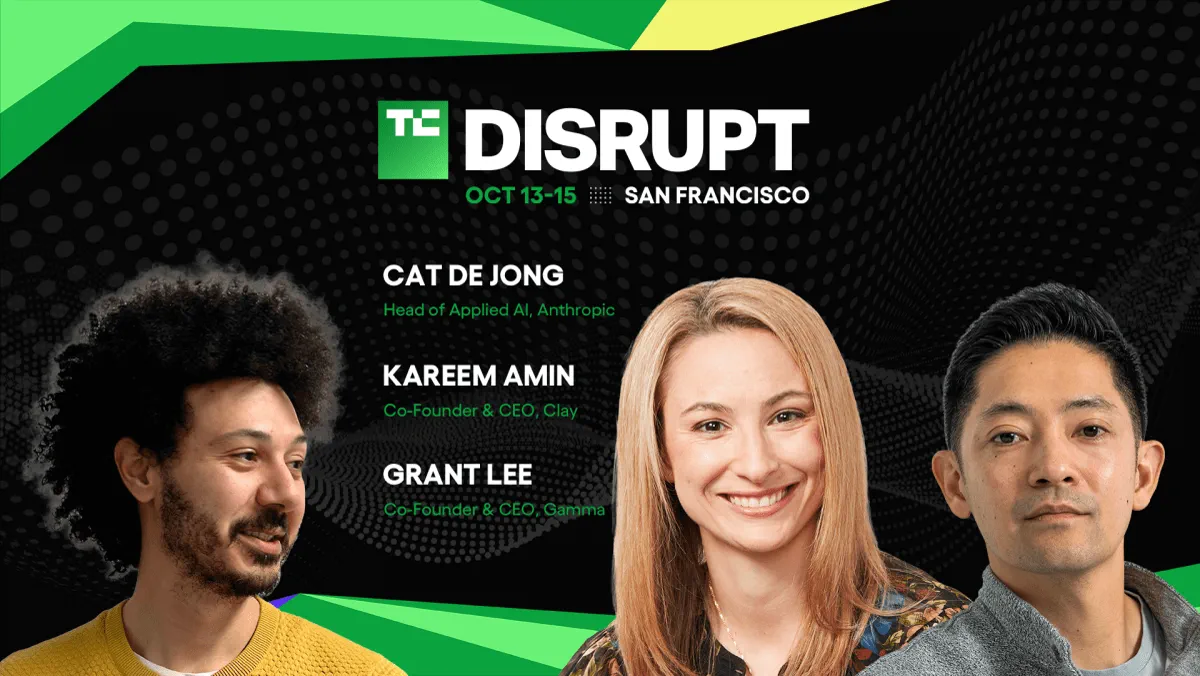
Leaders from foundation model giant Anthropic and high-growth enterprise software pioneers Gamma and Clay will convene at TechCrunch Disrupt 2026 this October in San Francisco to tackle the most pressing question facing enterprise tech: what actually happens when companies move artificial intelligence out of the demo sandbox and into production? Set to headline the conference's AI Stage, presented by Google for Startups, the session focuses on the structural, technical, and economic hurdles businesses encounter when transitioning from novelty prototypes to dependable enterprise deployments.
The announcement comes as the broader technology sector reaches an inflection point. While 2023 and 2024 were defined by jaw-dropping generative AI demos and ballooning proof-of-concept budgets, 2026 has brought acute corporate scrutiny. TechCrunch Disrupt 2026, running from October 13 to October 15, 2026, at Moscone West in San Francisco, has expanded its programming—adding a Real World AI Stage alongside its signature AI and Builders stages—to address the widening gap between AI ambition and enterprise execution.
Beyond the Hype: Bridging AI's "Demo Chasm"
For nearly four years, the tech industry has been inundated with viral demonstrations showing AI agents writing complex code, drafting marketing decks, and generating personalized sales pipelines in seconds. Yet enterprise IT leaders have found that building a prototype that works 80% of the time in a controlled environment is trivial compared to deploying software that performs reliably at 99.9% uptime within strict regulatory, compliance, and privacy constraints.
Industry research across 2025 and 2026 reveals that more than 50% of corporate generative AI initiatives stall during or immediately after the pilot phase. The root cause is rarely a deficiency in the raw intelligence of large language models (LLMs). Instead, enterprise rollouts routinely break down due to hallucination risks, non-deterministic outputs, brittle integrations with legacy database architectures, and unpredictable token-consumption costs.
At Disrupt 2026, the discussion will focus directly on surviving this "demo chasm." Rather than treating AI as an open-ended lab experiment, Anthropic, Gamma, and Clay will outline how modern software teams must engineer deterministic guardrails, structured evaluation harnesses, and human-in-the-loop workflows to deliver verifiable business value.
The Disrupt 2026 Lineup: Foundation, Design, and Data Orchestration
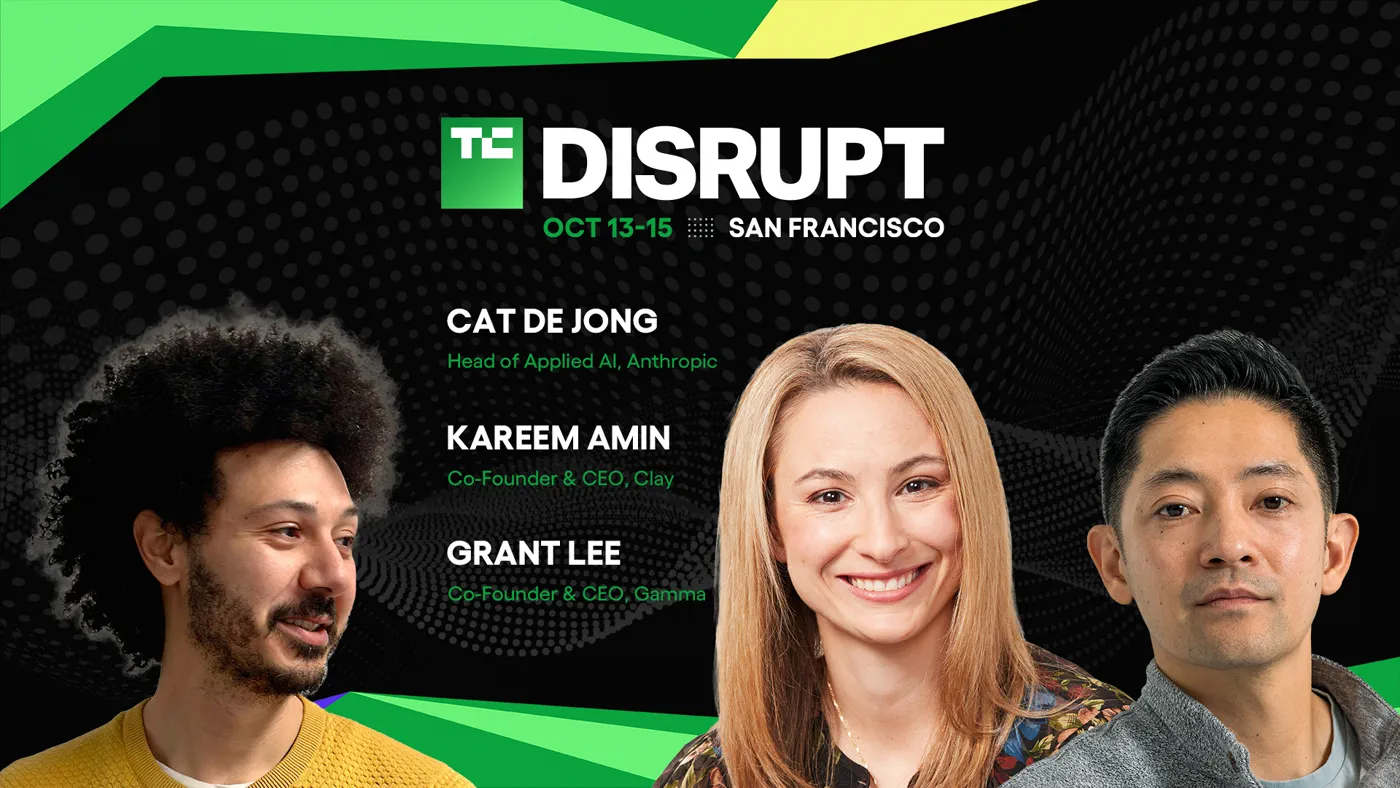 Photo: TechCrunch (source)
The panel brings together three critical vantage points across the modern enterprise AI architecture:
- Anthropic (Foundation Layer): As the developer of Claude and one of the world's preeminent frontier AI research labs, Anthropic represents the foundational intelligence layer. Anthropic has distinguished itself among enterprise customers through its intense focus on safety, constitutional AI, steerability, and open integration protocols like the Model Context Protocol (MCP).
- Gamma (Presentation & Knowledge Layer): Led by co-founder and CEO Grant Lee, Gamma has disrupted long-standing visual productivity suites. Built around prompt-to-presentation workflows, Gamma reached $100 million in annual recurring revenue (ARR) and expanded to over 70 million users with a lean team of roughly 50 employees, demonstrating how AI-native products can achieve unprecedented capital efficiency.
- Clay (Data & Go-to-Market Orchestration): Co-founded and led by CEO Kareem Amin, Clay has emerged as the definitive AI-powered data enrichment and sales orchestration engine. By bridging more than 50 data providers into automated, AI-driven action loops, Clay acts not merely as a passive CRM record keeper, but as an active execution engine for go-to-market teams.
| Company | Core AI Layer | Primary Enterprise Value | Key Scaling Focus | Efficiency Milestone |
|---|---|---|---|---|
| Anthropic | Frontier Foundation Models (Claude) | Deep reasoning, safety guardrails, contextual protocol standards (MCP) | Enterprise data governance, reliability benchmarks, zero data-retention security | Leading frontier AI lab powering Global Fortune 500 workflows |
| Gamma | Visual Communication & Content Generation | Instant generation of interactive presentations, docs, and web pages | Eliminating "AI slop," auto-branding, frictionless employee adoption | Scaled to $100M ARR and 70M+ users with only ~50 staff |
| Clay | Go-to-Market Data Orchestration | Automated data enrichment, intent signal analysis, 1-to-1 personalized campaigns | Multi-source data waterfalls, action-driven workflows over static CRM records | Trusted by 100,000+ users and thousands of high-growth B2B teams |
What Breaks When Enterprises Actually Deploy AI
When enterprise IT departments connect frontier LLMs to proprietary company databases, existing corporate infrastructure faces four common failure modes:
- The Context and Integration Trap: Standard foundation models lack real-time visibility into siloed corporate repositories. Without open standards like MCP to standardize how external data connects to LLMs, custom one-off API connectors quickly become a maintenance nightmare.
- The Output Quality Deficit: In productivity and creative software, initial AI drafts frequently suffer from generic styling—colloquially labeled "AI slop." Deploying AI at scale requires systems that automatically adhere to strict corporate brand guidelines, tone of voice, and regulatory disclosures without requiring exhaustive prompt engineering from end users.
- Data Quality and Hallucination Exposure: AI deployed in customer-facing functions or outbound marketing cannot afford factual errors. Enterprises must implement automated "waterfall" verification—querying multiple corroborating data sources before executing an outreach email or committing an automated record to a database.
- Security and Compliance Redlines: Large organizations in financial services, healthcare, and defense enforce strict rules against using customer data for model retraining. Ensuring end-to-end data residency,SOC 2 Type II compliance, and zero-day data retention remains non-negotiable.
The SaaS Reckoning: Moving from Seats to Outcomes
 Photo: TechCrunch (source)
A central focus of the upcoming session will be the seismic economic shift reshaping enterprise software pricing. Traditional software-as-a-service (SaaS) companies built multi-billion-dollar empires by charging monthly subscription fees per user "seat." However, AI-native platforms are fundamentally designed to reduce manual human effort, rendering seat-based metrics obsolete.
Both Gamma and Clay have pioneered models that blend usage-based credits, API consumption, and value-delivered pricing tiers. When an automated workflow handles the research and copywriting previously requiring a team of ten sales development representatives, enterprises expect to pay for the work completed, not the software logins maintained. The panel will explore how enterprise buyers are actively revising their procurement criteria to demand clear return on investment (ROI) tied directly to labor efficiency and throughput rather than software utilization rates.
Practical Advice for Enterprise Technology Buyers
For CIOs, product leaders, and engineering teams navigating enterprise AI deployments today, the collective experience of Anthropic, Gamma, and Clay offers actionable guidance:
- Decouple the UI from the Model: Treat foundation models as swappable commodity engines. Structure enterprise architecture around robust protocol layers (such as MCP) so workflows can seamlessly toggle between newer, cheaper, or faster models without re-architecting systems.
- Focus on "Systems of Action," Not Just "Systems of Record": Storage databases like legacy CRMs are no longer sufficient. Enterprise value flows to tools that directly synthesize data and initiate concrete business actions autonomously.
- Mandate Tight Feedback Loops: Establish continuous evaluation pipelines where employees can easily rate, adjust, and flag AI mistakes. Deployed systems must actively learn from human corrections rather than repeating errors across organizational silos.
What Happens Next
TechCrunch Disrupt 2026 takes place October 13–15, 2026, at the Moscone West convention center in San Francisco. Alongside the AI Stage discussion featuring Anthropic, Gamma, and Clay, the event will showcase its premier Startup Battlefield 200 competition, bringing together venture capitalists, early-stage founders, and institutional operators. Attendees registering ahead of the event can take advantage of conference promotional rates, including 50% off a second pass.
As corporate AI budgets face unprecedented scrutiny heading into 2027 planning sessions, the insights delivered on the Disrupt stage will provide a critical roadmap for whether AI continues to mature into durable operational software or remains trapped in an endless cycle of proof-of-concept experimentation.
FAQ
When and where is TechCrunch Disrupt 2026 taking place? TechCrunch Disrupt 2026 runs from October 13 to October 15, 2026, at Moscone West in San Francisco, California.
What is the core focus of the session featuring Anthropic, Gamma, and Clay? The session explores the technical, organizational, and operational hurdles companies face when transitioning artificial intelligence from prototype demos into live, high-scale enterprise environments.
Why are enterprise AI pilots frequently stalling before full deployment? Most pilots stall due to data silos, unreliable non-deterministic model outputs, strict regulatory and security compliance hurdles, and the operational complexity of integrating LLMs into legacy enterprise workflows.
How is enterprise AI altering traditional software pricing? Enterprise AI is shifting vendor pricing away from conventional per-user seat subscriptions toward consumption-based, credit-based, and outcome-oriented pricing structures that charge for work completed rather than active user accounts.