Frontier artificial intelligence labs are rapidly cooling on mass-market consumer software, retreating from speculative consumer products to shelter inside high-margin enterprise software contracts. The sudden shift is not happening because underlying foundation models are failing to impress, but because the brutal unit economics of serving unmetered compute to everyday consumers have become mathematically untenable.
Behind closed doors and across public balance sheets, the math of consumer AI is unraveling. While venture capital subsidized years of exploratory chat apps, open-ended video generators, and creative assistants, the realities of high inference costs, rapid subscriber turnover, and razor-thin conversion rates have forced industry leaders like OpenAI, Anthropic, and Google to rethink where they deploy their most expensive compute.
The Broken Math: Gym Economics Meet Reasoning Tokens
For nearly two decades, consumer software thrived on traditional cloud economics: once an application was written, serving a marginal user cost fractions of a cent in bandwidth and database hosting. Consumer AI fundamentally inverts that formula. Every single prompt, code revision, and reasoning step requires dedicated, high-demand GPU clusters.
To attract early adopters, frontier labs relied on what industry analysts call "gym economics"—the assumption that a large pool of low-activity subscribers paying $20 to $200 per month would subsidize the occasional power user. In practice, the opposite occurred. As labs released complex reasoning models like OpenAI’s o-series and GPT-6 Astra or Anthropic’s Claude Opus line, power users began looping agentic tasks, running automated coding environments, and executing multi-step research. Telemetry across the sector revealed that an active power user on a $200 monthly plan could easily consume between $5,000 and $27,000 in actual API-equivalent compute. This created an unsustainable 25x to 40x subsidy ratio that quietly drained balance sheets.
| Economic Dimension | Consumer AI Model | Enterprise B2B Model |
|---|---|---|
| Primary Pricing Mechanism | Flat subscription ($20–$200/mo) or free ad tier | Per-seat base ($20+/user) plus metered API tokens |
| Free-to-Paid Conversion | Low (estimated ~3% industry average) | High (contracted enterprise seats, low leakage) |
| Churn Rate vs. Traditional SaaS | ~30% faster churn than standard apps | Multi-year contracts, low annualized churn |
| Compute Cost Scaling | Scales directly with open-ended consumer sessions | Capped by corporate IT governance and usage budgets |
| Gross Margin Profile | Frequently negative or compressed single digits | 60% to 80% software-like margins |
| Value Justification | Personal convenience, novel entertainment | Measurable labor productivity and head-count efficiency |
The Retention Cliff and the "Second Session" Problem
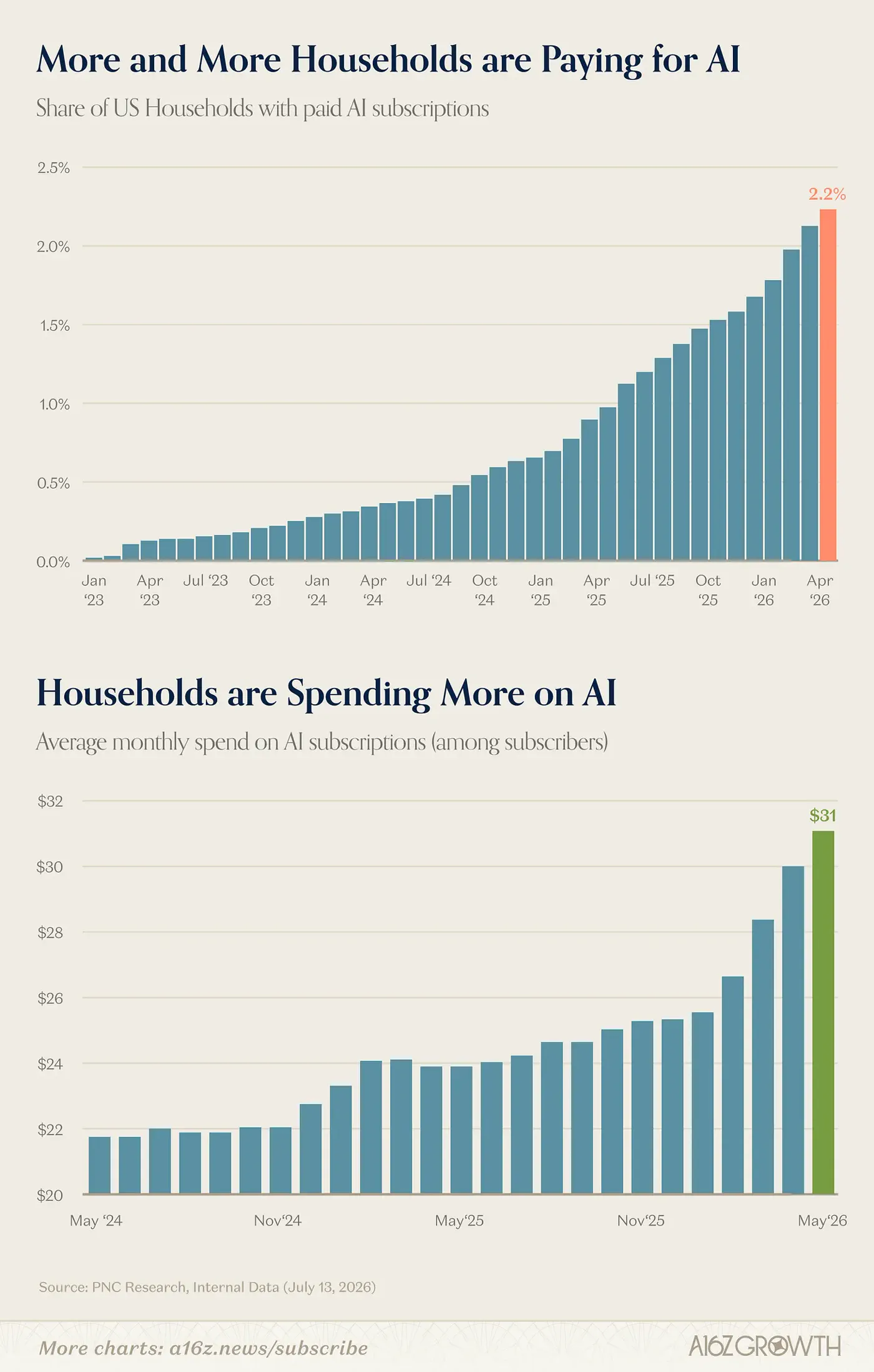 Photo: TechCrunch (source)
High infrastructure overhead is only half of the consumer dilemma; the other half is audience retention. Recent ecosystem data from market intelligence groups like GP Bullhound highlights what founders call the "Second Session" problem. While modern AI tools make it remarkably simple to deliver an astonishing first experience, turning initial curiosity into a daily habit remains elusive.
More than 100,000 new AI-powered mobile apps launch each month, creating fierce competition for consumer attention. While AI-centric apps command roughly 41% higher revenue per paying user than non-AI apps, they also churn 30% faster. Consumers download a chatbot or photo generator, marvel at the output, pay for one or two billing cycles, and abruptly cancel once the novelty wears off. Because only about 3% of consumer AI users ever upgrade to a paid tier, every paying customer's margin must offset the infrastructure tab of roughly 33 free users. When paying subscribers leave, the entire unit economic structure collapses.
The Casualties: From Sora to Strict Compute Quotas
Nothing exemplifies the collapse of consumer AI economics more vividly than the fate of OpenAI's standalone video generator, Sora. Sora launched to massive fanfare, racing past 1 million downloads in under five days. Yet behind the viral clips lay an operational furnace.
By early 2026, reports revealed Sora was burning approximately $1 million per day in compute infrastructure while generating just $2.1 million in lifetime in-app purchase revenue. Confronting theoretical peak inference costs estimated by analysts at up to $15 million per day, OpenAI pulled the plug on the consumer application and subsequently deprecated the developer-facing Sora API on September 24, 2026, without naming a successor.
Across the industry, surviving consumer products are locking down access:
- Rolling compute bars and strict hourly caps: Both OpenAI and Anthropic have aggressively rolled back unmetered prompt access, introducing hourly request limits and dynamic throttling during peak cloud hours.
- Harness restrictions: Labs have cracked down on automated third-party tools tapping into consumer subscriptions, cutting off workflows that treated flat-rate web accounts like discounted backend APIs.
- Introduction of advertising: OpenAI began rolling out ad-supported layers and budget tiers to monetize the massive, non-paying long tail of free users who refuse to pay monthly fees.
Why Labs Are Sprinting to the Enterprise
 Photo: cleverhack.com (source)
With consumer margins under pressure, frontier labs are executing a decisive pivot toward business software. At its developer conference in late September 2026, OpenAI introduced "Dots," continuous, autonomous agents running on its GPT-6 Astra model, paired with collaborative enterprise workspaces designed to integrate directly with corporate tools like Microsoft Teams and Slack.
Similarly, Anthropic committed $100 million to its Claude Partner Network, aligning directly with major systems integrators including Deloitte, PwC, KPMG, and Accenture. Meta, despite finding runaway consumer success with its Muse agent—which racked up 2.8 million downloads to top the App Store—quickly announced a parallel enterprise agent push to sell managed services and dedicated infrastructure directly to corporate buyers.
Enterprise software solves the lab's primary balance-sheet crisis. Corporations do not expect unmetered compute for a flat $20 bill; they sign multi-year agreements, pay metered per-token consumption charges, and measure cost against payroll productivity. A single Fortune 500 contract can guarantee predictable, audited millions without risking rogue consumer power users bankrupting the service.
What It Means for Everyday Users and Developers
For general consumers, the era of free or dirt-cheap, unlimited frontier intelligence is over. Users should prepare for a far more transactional digital landscape:
- Tighter quotas on top models: Flagship frontier models will increasingly be reserved for enterprise tiers or metered consumption. Free and standard $20 tiers will run on smaller, distilled models.
- More ads and sponsored recommendations: Expect search engines and free conversational interfaces to increasingly introduce sponsored answers to subsidize backend compute.
- A crisis for "wrapper" startups: Small software startups that simply package frontier API calls inside a sleek consumer UI face a double bind: frontier labs are building their own native tools, while escalating token bills make low consumer prices impossible to sustain.
Developers building consumer products are increasingly forced to migrate down-market, swapping out massive frontier models for specialized open-weight models like Meta's Llama or Google's Gemma, which run at a fraction of the cost.
What Comes Next and Unanswered Questions
 Photo: shattered.io (source)
As the industry enters late 2026, the divergence between frontier capabilities and consumer accessibility will only widen. Menlo Ventures data indicates that while global consumer AI spending reached $40 billion, actual user growth flattened—moving only from 61% to 64% of US consumers. The market is not expanding outward; a narrow band of paying power users is simply paying more.
Several major questions remain unanswered. Can ad networks generate high enough cost-per-click rates to pay for the GPU cycles required to answer conversational queries? Will upcoming local hardware—such as on-device NPUs in next-generation phones and laptops—absorb enough inference to make consumer AI economically viable without cloud servers? Until those equations balance, frontier labs will continue keeping their most powerful, expensive technology behind the safe, lucrative paywalls of corporate IT.
FAQ
Why are frontier AI companies pulling back from consumer products? Frontier models require expensive high-end GPU compute for every single interaction, making standard flat-rate consumer subscriptions unprofitable when heavy users consume vastly more compute than their monthly fee covers.
Why did OpenAI shut down Sora? Despite millions of downloads, Sora reportedly cost around $1 million a day to operate while generating only about $2.1 million in lifetime mobile revenue, creating an unsustainable loss.
How much does an AI power user actually cost a company? Internal telemetry and industry evaluations indicate that an active power user running continuous reasoning tasks or automated coding on a $200 monthly plan can rack up between $5,000 and $27,000 in real API compute costs.
Are AI applications losing users faster than traditional software? Yes; industry data shows consumer AI applications churn approximately 30% faster than conventional apps, as many users abandon products once the initial novelty of generative output fades.
Will free AI assistants disappear completely? No, but uncapped free access to flagship reasoning models is disappearing. Free tiers will increasingly be powered by cheaper, lightweight models, restricted by strict hourly rate limits, and supported by digital advertising.