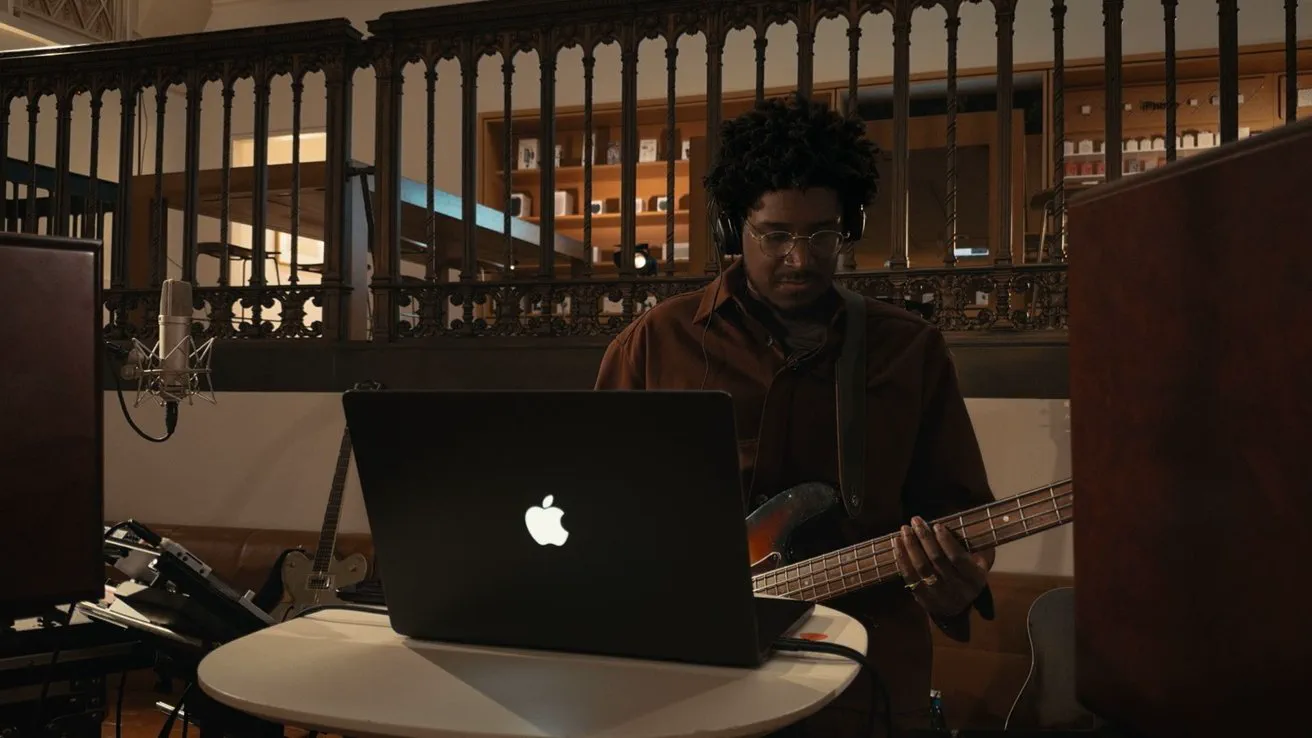
Apple Music officially released "Surrender," a brand-new single written and produced by multiplatinum British artist Labrinth entirely on Apple's newly released touchscreen MacBook Pro with PROLED XDR Display. The track debuted on Tuesday, November 10, 2026, following an overnight, nearly four-hour livestream from Apple Tower Theatre in downtown Los Angeles where Labrinth demonstrated the real-world music production capabilities of macOS and Logic Pro 13.
The Debut of "Surrender": A Track Built From Scratch in Public
The arrival of "Surrender" on Apple Music represents the culmination of an ambitious, high-stakes marketing campaign staged by Apple to promote its redesigned pro laptops. During the overnight recording session titled "Labrinth Live on Mac," streamed globally via YouTube from 8:00 p.m. PT on November 4 into the early morning hours of November 5, Labrinth sat inside the historic 1927 movie palace turned retail flagship in Los Angeles.
Rather than playing pre-recorded stems or executing a staged demonstration, the Emmy-winning and Grammy-nominated producer built an entire arrangement from a blank project file. Viewers watched in real time as Labrinth brainstormed melodies, programmed rhythm tracks, layered analog-style synths, captured vocal takes, and balanced the mix. Apple has also released an edited highlight reel on YouTube capturing the creative workflow. As Labrinth summarized during the session: "I can literally touch my project now". The finished studio single is now streaming on Apple Music (accessible via the standard $11.99 monthly plan or Apple One bundles) and is rolling out across rival streaming services.
Inside the Session: Putting Logic Pro 13 Touch to the Test
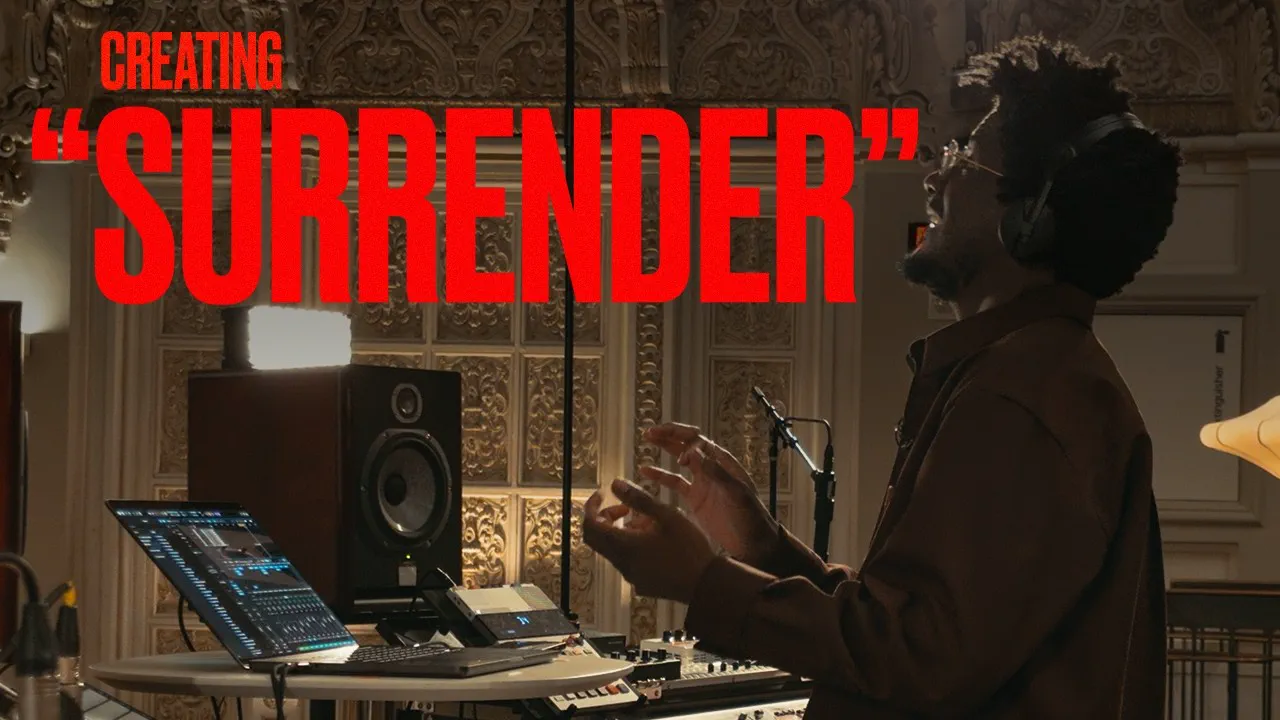 Photo: appleinsider.com (source)
For professional audio engineers and digital audio workstation (DAW) users, the demonstration offered the first extended, unedited look at how Apple's newly updated DAW software, Logic Pro 13, leverages multi-touch interaction on a laptop. Labrinth spent much of the session interacting with the display using hands-on gestures rather than relying solely on the trackpad:
- Play Surface: Replacing conventional musical typing, the resizable onscreen performance layout allowed Labrinth to trigger chord pads, drum banks, and an onscreen keyboard with velocity modulation and polyphonic pitch glides directly on the glass.
- Multi-Fader Mixing: Labrinth grabbed and adjusted multiple virtual mixer faders simultaneously using several fingers—a tactile mixing technique previously restricted to physical hardware control surfaces or iPads running Logic Remote.
- Sample Manipulation in Sample Alchemy: Direct multi-finger scrubbing and point-manipulation let him sculpt vocal grains and audio snippets directly on the screen.
- Dynamic EQ and Remix FX: Labrinth shaped EQ filter envelopes and dynamic modulation sweeps by pinching, dragging, and automating filter curves on the fly.
- Smart Browser and Splice Integration: Logic Pro 13's updated sound management automatically indexed, classified, and tempo-matched samples to streamline the arrangement without breaking the creative flow.
Throughout the four-hour stream, the session underscored that touch in macOS is designed to augment existing muscle memory rather than replace it; Labrinth frequently paired left-hand keyboard shortcuts and trackpad navigation with right-hand touchscreen adjustments.
Hardware and Software in Harmony: The PROLED XDR MacBook Pro
The laptop at the center of the broadcast launched in retail stores on Friday, November 6, 2026, marking Apple's entry into the touchscreen laptop market. Equipped with Apple's M5 Pro and M5 Max silicon, the MacBook Pro with PROLED XDR Display replaces mini-LED backlights with a tandem OLED panel that integrates a capacitive touch digitizer directly into the display stack.
MacBook Pro (PROLED XDR) Key Specifications and Pricing
| Feature | 14-inch MacBook Pro (PROLED XDR) | 16-inch MacBook Pro (PROLED XDR) |
|---|---|---|
| Starting Price | $2,899 | $3,399 (M5 Pro) / $4,799 (M5 Max) |
| Display Type | Tandem OLED touchscreen with ProMotion | Tandem OLED touchscreen with ProMotion |
| Display Resolution | 3024 x 1964 native resolution | 3472 x 2266 native resolution |
| Brightness | 1,000 nits sustained SDR/XDR; 2,000 nits peak HDR | 1,000 nits sustained SDR/XDR; 2,000 nits peak HDR |
| Camera Enclosure | Dynamic Island pill cutout (replaces notch) | Dynamic Island pill cutout (replaces notch) |
| Processor Options | M5 Pro (15-core CPU, 16-core GPU) or M5 Max | M5 Pro (18-core CPU, 20-core GPU) or M5 Max (up to 40-core GPU) |
| Unified Memory | 24GB standard; configurable to 48GB, 64GB, or 128GB | 24GB / 36GB base; configurable up to 128GB |
| Internal Storage | 1TB up to 16TB SSD | 1TB / 2TB base up to 16TB SSD |
| Audio System | Six-speaker sound system with force-canceling woofers | Six-speaker sound system with 50% deeper bass response |
| Chassis Weight | Approx. 3.4 lbs | 4.0 lbs (M5 Pro) / 4.1 lbs (M5 Max) |
| Color Finishes | Silver, Space Black | Silver, Space Black |
The laptops feature a thinner chassis profile at 0.63 inches and replace the display notch with a pill-shaped Dynamic Island housing a 12MP Center Stage webcam.
Alongside the hardware, Apple launched Logic Pro 13 as a free update for existing perpetual license owners and Creator Studio subscribers. The update introduces a dark "Liquid Glass" user interface, enhanced stem splitting capable of isolating individual drum elements (kick, snare, hi-hats, cymbals), and an on-device AI production assistant developed in partnership with OpenAI (reserved exclusively for Creator Studio subscribers on macOS 27).
The Long Journey to Apple's First Touchscreen Mac
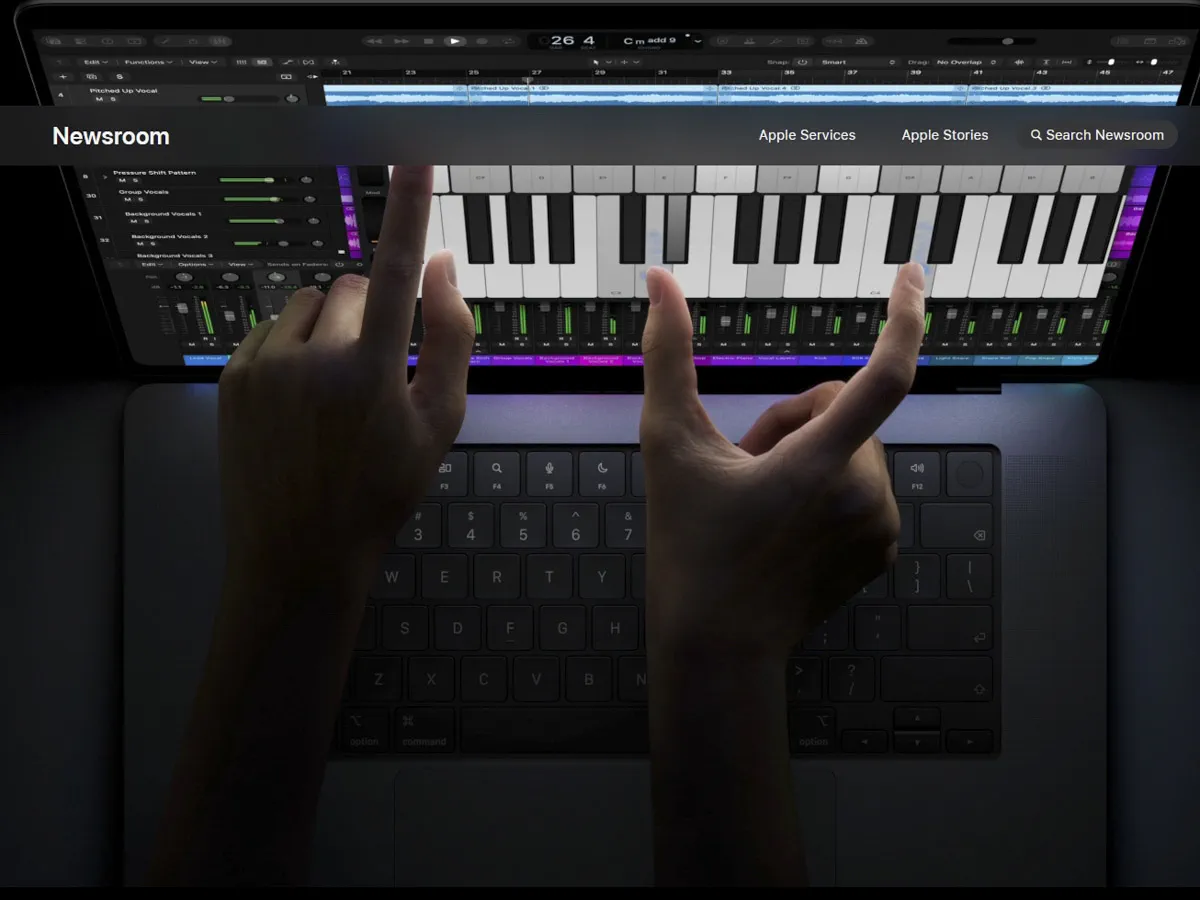 Photo: notebookcheck.net (source)
For nearly two decades, Apple leadership steadfastly rejected the concept of touch-enabled MacBooks. Former CEO Steve Jobs famously described vertical touchscreens in 2010 as "ergonomically terrible," arguing that prolonged arm extension led to physical discomfort, colloquially dubbed "gorilla arm." When competitors flooded the market with Windows 8 convertibles and 2-in-1s, Apple instead offered the Touch Bar in 2016—a narrow OLED strip above the keyboard that was ultimately discontinued in 2021 after widespread user criticism.
What changed? Display engineering and software maturity. By integrating tandem OLED panels with micro-textured glass, Apple eliminated the optical glare and display degradation that previously plagued pro laptop panels. Concurrently, cross-platform UI frameworks unified touch targets across iPadOS and macOS, enabling Apple to introduce direct screen input without transforming macOS into an oversized phone interface.
How It Compares to Windows 2-in-1s and iPad Pro
In entering the touchscreen laptop market, Apple has taken a deliberately different engineering approach than rivals:
- Form Factor vs. Windows Convertibles: Laptops like the Microsoft Surface Laptop Studio and HP Spectre x360 utilize 360-degree hinges or sliding easel displays that fold flat into digital drafting tables. Apple's MacBook Pro remains a rigid clamshell that opens to approximately 135 degrees. Users cannot fold it flat or flip it into a tablet mode.
- Precision vs. iPad Pro: While the 13-inch iPad Pro with M4 serves as a lightweight, touch-first tablet with optional Apple Pencil interaction, it runs iPadOS and lacks root file system access, legacy plugin hosting, and native windowing depth. The MacBook Pro provides a full desktop UNIX environment, support for heavy Audio Units (AU) plugin chains, and Thunderbolt 5 peripheral bandwidth.
- Input Philosophy: Unlike Windows 11, which shifts between tablet and desktop modes with varying touch-target sizes, macOS retains precise desktop mouse vectors, using multi-touch primarily as an auxiliary, multi-finger input surface for creative sliders, gestures, and audio instruments.
Industry Reactions: Studio Innovation or Expensive Novelty?
 Photo: ictbyte.com (source)
The music production community has greeted the release of "Surrender" and the touchscreen MacBook Pro with a mix of excitement and measured skepticism.
Producers on social media and DAW forums praised the ability to control multiple faders simultaneously without buying expensive third-party MIDI mixer controllers. Early hardware reviewers noted that while reaching over the keyboard for extended typing work can cause arm fatigue, using the display for micro-adjustments—such as twisting an effect knob, slicing a waveform, or tapping in a beat—feels natural and faster than precision mousing.
However, some criticism has targeted the product's economics. With a starting price of $2,899—a $400 to $700 premium over previous mini-LED baselines—independent bedroom producers have questioned whether touch functionality justifies the cost. Audio engineers also noted with frustration that the flagship AI assistant in Logic Pro 13 is gated behind a monthly Creator Studio subscription rather than included in the perpetual DAW license.
What It Means for Creators and Buyers
If you are a music producer, audio engineer, or video editor considering upgrading, here is how the landscape shakes out:
- For Live Performers and Beatmakers: The touchscreen MacBook Pro reduces the amount of auxiliary MIDI hardware you need to travel with. Being able to launch Live Loops, play expressive synths, and adjust channel faders on the screen streamlines mobile rigs.
- For Traditional Studio Engineers: If your workflow revolves around external dual-monitor setups, motorized hardware mixing consoles, and dedicated mechanical keyboards, the touchscreen adds limited functional value to your desk.
- Display Professionals: Beyond touch, the tandem OLED panel delivers perfect black levels, zero mini-LED haloing, and full Adobe RGB / DCI-P3 color fidelity, making it a reference monitor for color grading and video finishing.
What Happens Next: The Third-Party Software Test
With "Surrender" proving that a commercially viable track can be created entirely through a touch-first macOS workflow, attention now turns to third-party developers. While Apple has tailored Logic Pro 13 and Final Cut Pro to support multi-touch gestures, standard macOS apps still lack touch optimization. The real test of the platform will depend on how rapidly industry-standard audio suites—such as Ableton Live, Avid Pro Tools, FL Studio, and Native Instruments—implement dedicated multi-touch mapping for the PROLED XDR display.
FAQ
What is Labrinth's new song called and where can I stream it?
The single is titled "Surrender". It is currently available to stream on Apple Music and is rolling out to other major digital streaming platforms.
How much does the new touchscreen MacBook Pro cost?
The 14-inch MacBook Pro with PROLED XDR Display starts at $2,899, while the 16-inch model begins at $3,399 for the M5 Pro chip and $4,799 for the M5 Max chip.
Can you still use a traditional keyboard and mouse on the new MacBook Pro?
Yes. The touchscreen does not replace traditional inputs; the laptop features a full-sized backlit Magic Keyboard with Touch ID and a Force Touch trackpad, allowing users to combine physical and touch controls seamlessly.
Does Logic Pro 13 touch support work on older Macs?
Logic Pro 13's new Play Surface and touch-oriented gestures can be controlled via a trackpad or mouse on older Macs, or through multi-touch if you tether an iPad using Apple's Sidecar feature. Direct on-screen touch, however, requires the new PROLED XDR MacBook Pro.
Does the new MacBook Pro convert into a tablet?
No. The MacBook Pro retains its classic clamshell form factor and does not fold backward into a slate or 360-degree 2-in-1 design.