Google has officially expanded its experimental personal intelligence app, Dreambeans, to India, marking the software’s first international rollout beyond the United States. Built by Google Labs, the mobile application creates proactive, personalized daily visual digests by pulling context from users’ connected Google accounts rather than waiting for written prompts.
Starting this week, Indian users aged 18 and older can download Dreambeans for free on both Android and iOS. The expansion brings broad regional language support, enabling visual lifestyle cards and event updates across 14 languages. The push comes at a critical juncture for Google’s consumer AI strategy, as the company seeks engaged international audiences following a dramatic post-launch slowdown in the United States.
What Dreambeans Does: A Proactive Digital Journal
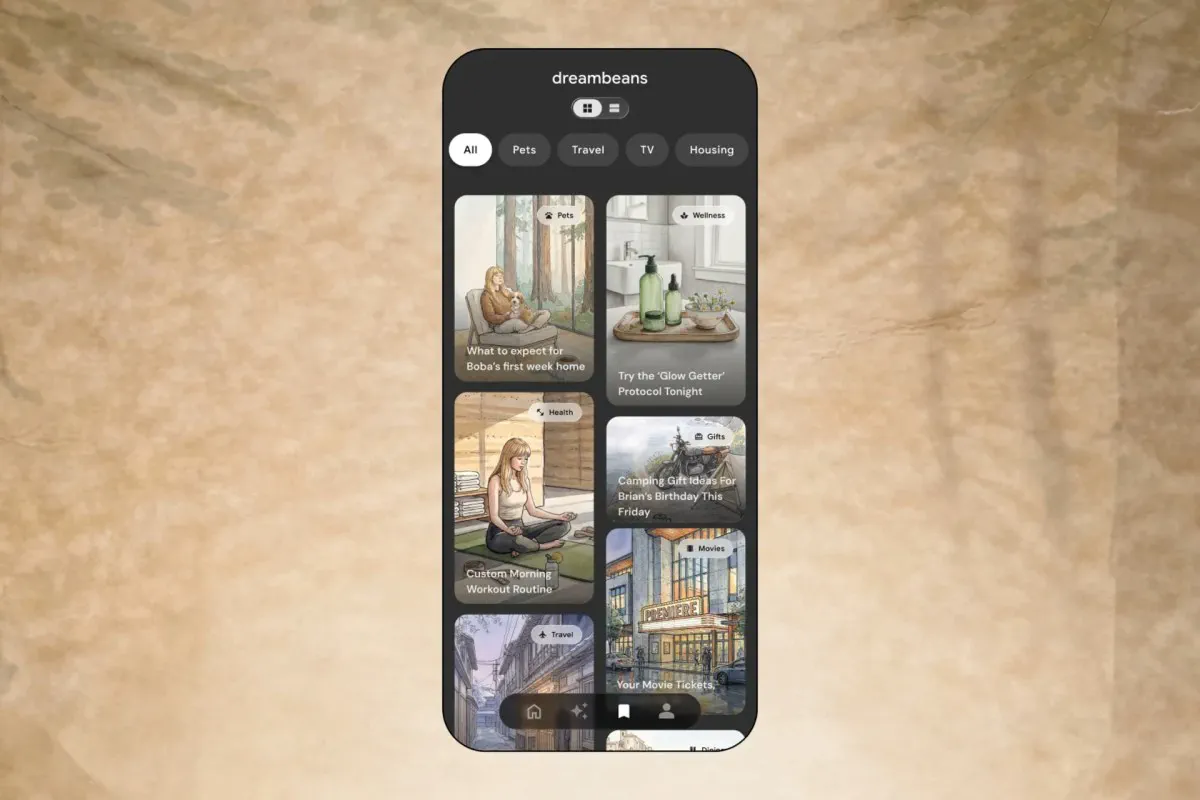
Unlike traditional conversational AI bots such as ChatGPT or Google Gemini, Dreambeans is built around unprompted discovery. The app operates on the premise that modern internet users suffer from digital fatigue and content fragmentation across disparate services. Instead of requiring users to formulate queries, Dreambeans analyzes data overnight to assemble a finite stack of 10 to 14 personalized story cards each morning.
Each "bean" acts as a bite-sized visual tile centered on personal lifestyle recommendations, upcoming tasks, creative inspiration, or local discoveries. For example, if a user receives an email confirming a kitchen gadget delivery, Dreambeans might compile recipe ideas using that appliance. If a calendar shows an upcoming road trip, the app can surface scenic pit stops or packing suggestions.
Crucially, the app avoids generic generative stock art. Dreambeans employs proprietary image generation along with Google DeepMind’s Veo video-generation model to animate select cards. Visuals are presented in a signature watercolor illustration aesthetic. When granted access to Google Photos, the app can even incorporate stylized, cartoon-like avatars of the user, friends, and family directly into the artwork.
The Technical Backbone and App Connectivity
 Photo: TechCrunch (source)
Dreambeans relies heavily on Google’s Personal Intelligence stack, linking multiple corners of a user's Google footprint into a single contextual layer. The service is restricted to personal Gmail accounts and does not support enterprise or Google Workspace business profiles.
Users must connect at least one Google service for the app to function, though Google notes the recommendations improve significantly as more services are integrated. During onboarding, users can selectively toggle permissions for six core Google services:
- Gmail: Scans confirmations, newsletters, reservations, and travel receipts.
- Google Calendar: Pulls schedules, appointments, and upcoming milestones.
- Google Photos: Supplies context for faces, travel locations, and nostalgic memories.
- Google Search History: Identifies emerging hobbies, research topics, and immediate curiosities.
- YouTube: Assesses viewing habits to recommend related creative activities and tutorials.
- Gemini: Synchronizes previous AI inquiries and user interests.
| Feature | Dreambeans Details |
|---|---|
| Developer | Google Labs |
| Launch Window | U.S. (June 2026), India (November 2026) |
| Platforms | Android, iOS |
| Pricing | Free (previously restricted to Google AI Ultra subscribers) |
| Account Eligibility | Personal Google Accounts (Ages 18+) |
| Connected Services | Gmail, Calendar, Photos, Search, YouTube, Gemini |
| Creative Engine | Bespoke watercolor models, DeepMind Veo (animation) |
| Language Count | 14 languages (English + 13 Indian regional languages) |
The India Bet: Why Multilingual Scale Matters
India represents Dreambeans' first international deployment. Google Labs selected India deliberately due to unusual customer engagement metrics. According to Gozde Oznur, Product Manager at Google Labs, India consistently registers among the world’s heaviest global user bases across Gemini, Gmail, and Google Photos simultaneously.
To address the market, Google added 13 regional Indian languages alongside English:
- Hindi
- Bengali
- Telugu
- Marathi
- Tamil
- Urdu
- Gujarati
- Kannada
- Malayalam
- Odia
- Punjabi
- Assamese
- Nepali
Despite this extensive list, Dreambeans arrives with a key technical constraint: single-language generation. While the underlying AI models can read inbound context written across diverse scripts and tongues, each story collection must be rendered in a single, user-chosen language. The platform cannot currently generate hybrid linguistic blends such as Hinglish—a mix of Hindi and English widely spoken across urban India.
The Trajectory: From AI Ultra Exclusive to Slumping US Numbers
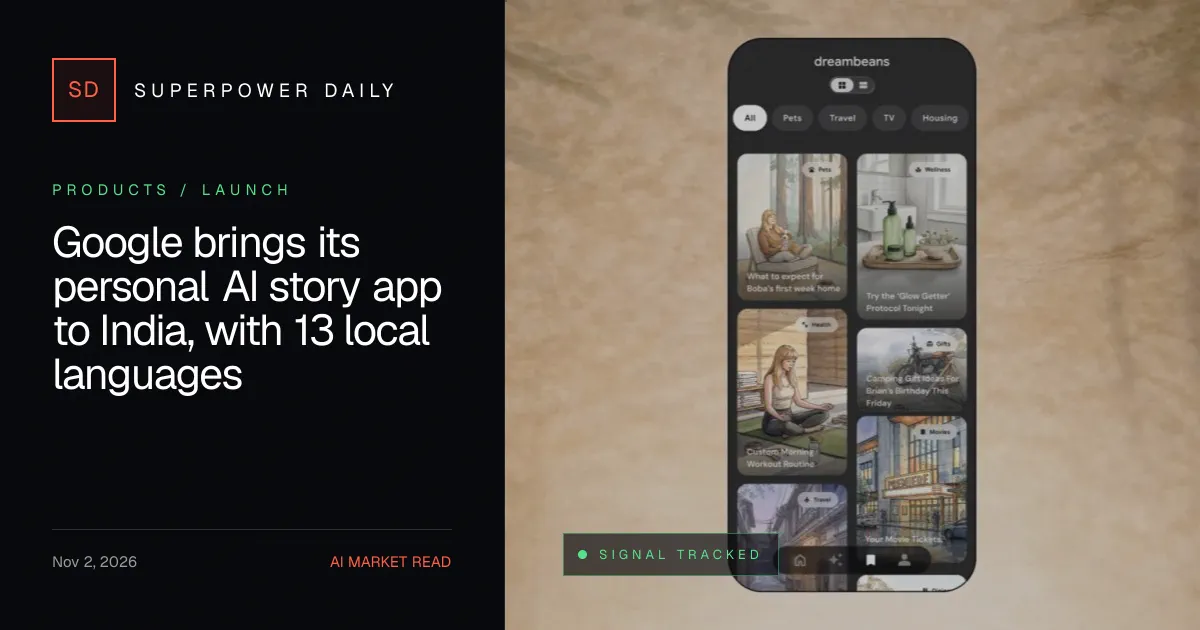 Photo: superpowerdaily.com (source)
The India launch follows a turbulent domestic trial in the United States. Google first debuted Dreambeans in June 2026 as an exclusive perk for subscribers to its $100-per-month Google AI Ultra plan. In September, the company dropped the paywall, opening the app to all eligible U.S. adult consumer accounts.
While the September public rollout produced an immediate spike, long-term retention remains uncertain. According to Sensor Tower estimates shared with TechCrunch, Dreambeans accumulated nearly 55,000 total U.S. downloads between June and October. Roughly 63% of those installations occurred during September’s public opening.
However, U.S. demand plunged sharply in October, falling 84% month-over-month to approximately 5,500 downloads. In its first 30 days of wide availability, Dreambeans captured 29,000 downloads—trailing far behind other consumer AI deployments like Meta’s Muse (7.4 million), ChatGPT (2.8 million), Grok Bot (362,000), and Anthropic’s Claude (155,000) during comparable debut windows. By expanding to India's smartphone ecosystem, Google hopes to find sustained, everyday utility for proactive AI feeds.
Privacy Controls, Hallucinations, and Sensitive Memories
Synthesizing personal correspondence, travel logs, and family photo libraries introduces considerable privacy and emotional challenges. Google emphasizes that Dreambeans stories are strictly private to the individual account holder and cannot be shared to an open algorithmic social network. Opt-in toggles configured within Dreambeans operate independently and do not impact privacy configurations in standalone Gemini apps or AI Mode.
Users can revoke app connections at any time and purge all accumulated Dreambeans profile data directly from in-app settings. Deleting source emails or photos removes them from the model’s active contextual index.
Emotional friction presents another hurdle. Because the AI proactively excavates years of digital footprints, it risks surfacing painful memories, including photos or references to deceased family members. Google has instituted topic-blocking controls mirroring Google Photos' memory filters, allowing users to exclude specific individuals, timeframes, or business-related subject matter.
Furthermore, Google acknowledges the models can hallucinate incorrect schedules or misunderstand personal dynamics. To counter errors, Dreambeans provides a "thumbs down" button and a sparkle tuning chip on every tile. Feedback triggers a brief chat interface to clarify preferences, which the backend system recalibrates overnight before delivering the next morning's cards.
What It Means for Users and What Comes Next
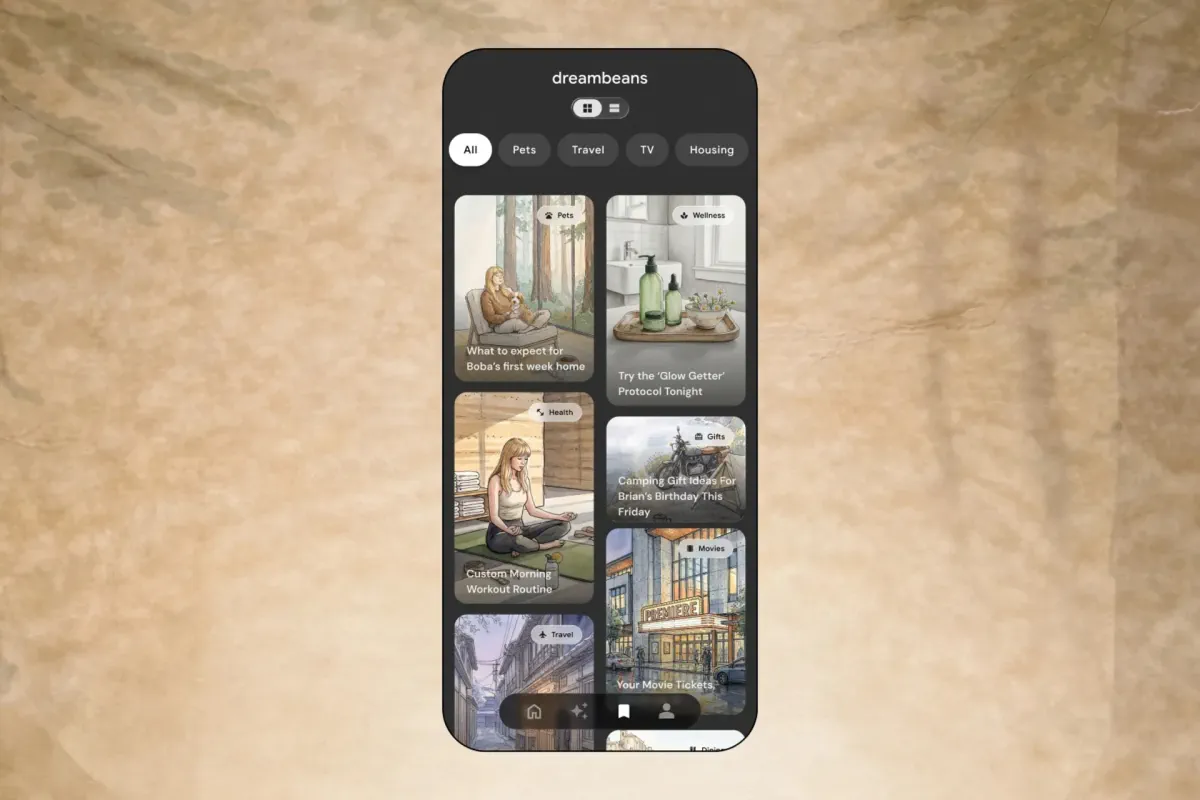 Photo: superpowerdaily.com (source)
For everyday consumers, Dreambeans provides an intriguing alternative to infinite-scroll social media feeds. By delivering a finite, curated morning overview of tasks, hobbies, and personal memories, it shifts AI from a reactive search tool into an ambient personal assistant.
Looking ahead, Google Labs aims to transform Dreambeans from a passive visual journal into an actionable utility. Product Manager Gozde Oznur indicated that Google is actively exploring ways to help users act directly on recommendations—such as one-tap restaurant bookings, ticket purchasing, or project scheduling—directly inside the story cards. Whether international audiences embrace an AI that reads their mail to paint daily cartoons remains Google’s biggest unanswered question.
FAQ
Is Google Dreambeans free to use in India?
Yes, Dreambeans is free to download for both Android and iOS users aged 18 and older holding personal Google accounts. It is not available for enterprise Google Workspace accounts.
Can Dreambeans mix languages like Hinglish?
No. While the app can analyze inputs written across multiple languages, generated stories must be viewed in one designated language at a time.
Can other people see my Dreambeans stories?
No. Dreambeans is not a social network; all generated visual stories are completely private and accessible only to the logged-in account holder. Users can, however, manually share individual cards with friends if they choose.
How do I stop Dreambeans from showing sensitive people or topics?
Users can tap the tuning controls or thumbs-down icon on any card to block specific subjects or individuals, similar to hiding faces and memories in Google Photos.
What happens if I disconnect an app like Gmail or Photos?
Disconnecting an app in the Dreambeans settings immediately revokes permission, preventing the engine from using data from that service for future story generation.