Transitioning to an electric vehicle introduces drivers to a whole new vocabulary of voltages, kilowatts, and charging tiers. While the EV industry has standardized equipment into Level 1, Level 2, and Level 3 categories, determining which tier best fits your daily routine depends far more on your commute distance, electrical infrastructure, and budget than simply chasing the highest charging speed.
Many prospective buyers assume that owning an EV requires spending thousands of dollars on high-voltage home upgrades or relying on rapid commercial plugs. In reality, battery chemistry, onboard converters, and basic driving habits mean the slowest, cheapest option might actually be all you need.
Decoding the Three Levels of EV Charging
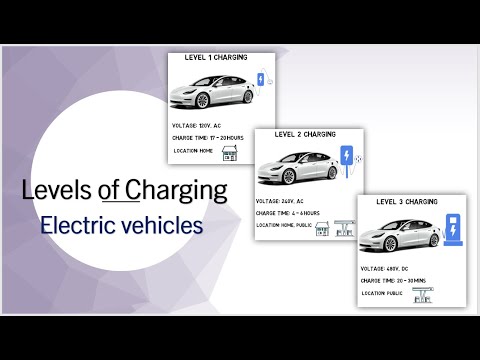
Electric vehicle chargers are segmented by input voltage, power delivery, and where the electrical current is converted:
- Level 1 Charging: Operates on standard 120-volt alternating current (AC) household outlets in North America. It typically draws 12 amps on a dedicated 15-amp circuit, delivering roughly 1.4 kW of continuous power. Every EV sold includes a portable Level 1 charging cord.
- Level 2 Charging: Uses 240-volt AC circuits—the same high-voltage connection powering residential clothes dryers, water heaters, and electric ranges. These units generally deliver between 3.3 kW and 19.2 kW, drawing anywhere from 16 amps to 80 amps depending on the breaker size and vehicle onboard limits.
- Level 3 Charging (DC Fast Charging): Operates on commercial 400-volt to 800-plus-volt direct current (DC) systems. Rather than feeding alternating current into the vehicle, these industrial cabinets supply direct current straight to the battery pack at rates between 50 kW and 350+ kW.
Watch: Levels of charging electric vehicles | Level 1, Level 2, Level 3
Video: Owl WiS on YouTube
Charging Tiers Compared: Specs, Speeds, and Hardware
 Photo: Engadget - Technology News & Expert Reviews (source)
| Specification | Level 1 (Household AC) | Level 2 (High-Power AC) | Level 3 (DC Fast Charging) |
|---|---|---|---|
| Supply Voltage | 120V AC | 240V AC | 400V – 800V+ DC |
| Current (Amps) | 12A – 16A | 16A – 80A | Up to 500A+ |
| Power Delivery | ~1.4 kW – 1.9 kW | 3.3 kW – 19.2 kW | 50 kW – 350+ kW |
| Miles of Range / Hour | 3 – 5 miles | 12 – 40+ miles | 150 – 200+ miles (in 30 min) |
| Full Charge Time | 24 – 40+ hours | 4 – 10 hours | 20 – 40 minutes (to 80%) |
| Hardware / Install Cost | $0 (included with vehicle) | $500 – $2,500 installed | $50,000+ (commercial only) |
| Primary Location | Home garages, rentals | Homes, workplaces, retail | Highway corridors, rest stops |
| Connector Types | J1772, NACS (Tesla) | J1772, NACS (Tesla) | CCS, NACS, CHAdeMO |
The Technical Difference: AC vs. DC Conversion
To understand why charging speeds jump so dramatically between Level 2 and Level 3, you have to look inside the vehicle. The municipal power grid delivers alternating current (AC), but lithium-ion battery packs can only absorb direct current (DC).
When you connect to a Level 1 or Level 2 supply, the vehicle's internal onboard charger handles the AC-to-DC conversion. Because this onboard equipment must fit inside the chassis and manage heat dissipation, its capacity is strictly capped—often between 7.4 kW and 11.5 kW on modern consumer vehicles. Even if you plug into an 80-amp commercial Level 2 station capable of 19.2 kW, a car with a 7.7 kW onboard inverter cannot draw power any faster.
Level 3 stations bypass the car's internal hardware entirely. Giant external converter cabinets convert grid AC into high-voltage DC power before sending it through thick, liquid-cooled charging cables directly to the battery pack. This eliminates the vehicle's onboard converter bottleneck and allows hundreds of kilowatts to pour in simultaneously.
The Case for Level 1: When Slow Charging Is Enough
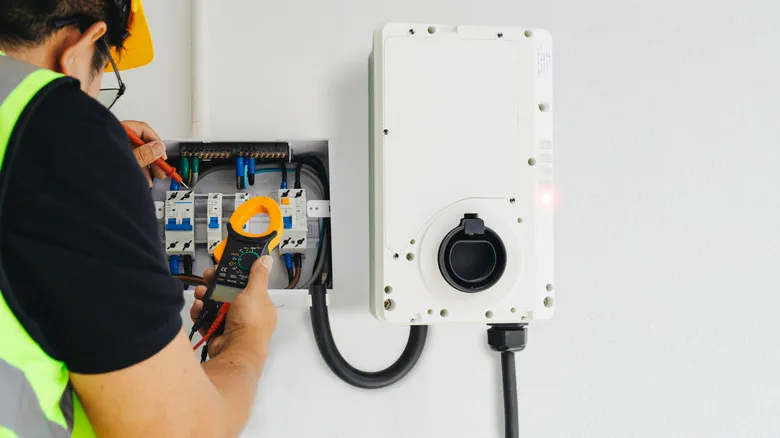 Photo: Engadget - Technology News & Expert Reviews (source)
Automotive marketing often focuses on peak replenishment speeds, leading owners to believe that a 40-hour charge time on a Level 1 outlet makes standard wall plugs unusable. But an EV does not function like an empty fuel tank that must be filled from 0 to 100 percent in a single sitting.
According to federal commuting data, the average American drives roughly 30 to 40 miles per day. A standard Level 1 charger plugged into an ordinary outlet adds 3 to 5 miles of range per hour. If a vehicle stays parked in a garage from 6:00 PM to 7:00 AM—a 13-hour overnight window—Level 1 charging reliably restores 40 to 65 miles of range, fully replacing an average day of driving before morning.
Level 1 charging requires zero up-front installation expenses and avoids load calculations on older residential breaker panels. For plug-in hybrid electric vehicles (PHEVs)—such as the Toyota Prius Prime or RAV4 Prime with small 14 kWh to 18 kWh packs—a 120V outlet can fully restore an empty battery overnight in 8 to 12 hours without needing a dedicated charging station.
Why and When to Upgrade to Level 2
While Level 1 handles light daily travel, Level 2 remains the sweet spot for pure battery-electric vehicles (BEVs). Stepping up to a 240V, 32-amp or 48-amp circuit provides several concrete advantages:
- Rapid Turnarounds: If you return home from work with an empty battery and have evening errands or a spontaneous trip, Level 1 will not replenish enough range in two hours. Level 2 adds 25 to 35 miles of range per hour, restoring 60 to 70 miles in a short evening stop.
- Off-Peak Electricity Pricing: Time-of-use (TOU) utility rates often offer discounted electric rates during narrow midnight windows (such as midnight to 6:00 AM). Level 1 chargers draw power too slowly to complete a charge in that window, whereas a Level 2 unit can replenish 150 to 200 miles within off-peak hours.
- Cold-Weather Preconditioning: In freezing conditions, heating an EV's cabin and battery pack requires substantial energy. A Level 1 outlet supplies only 1.4 kW—less energy than a cold-weather heater draws—meaning the car must pull energy from its battery during remote start. Level 2 provides enough throughput to warm the car entirely from grid power before unplugging.
The Realities of Level 3: Convenience vs. Battery Stress
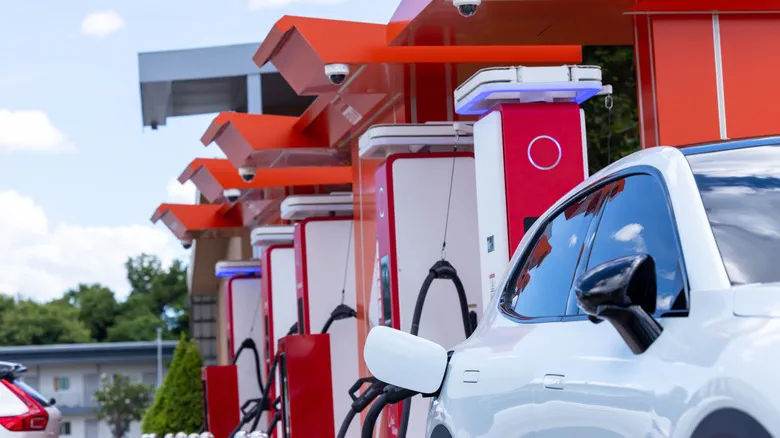 Photo: Engadget - Technology News & Expert Reviews (source)
Level 3 DC fast chargers are crucial for cross-country highway travel, allowing drivers to stop for 20 to 30 minutes, grab a bite to eat, and depart with an 80 percent charge. However, DC fast charging is neither practical nor desirable as a sole charging source.
First, Level 3 power delivery generates immense internal heat. Vehicle battery management systems throttle intake above 80 percent state-of-charge to minimize degradation, resulting in a steep "charging curve" slowdown. Consistently relying on DC fast charging exposes cell chemistry to repeated thermal stress compared to gentle Level 1 and 2 AC replenishment.
Second, public fast charging eliminates the primary economic benefit of driving an electric car. Residential electricity in the US averages roughly 16 cents per kilowatt-hour (kWh), while commercial DC fast charging networks frequently bill 40 to 60 cents per kWh. Over a year of driving, relying solely on commercial DC stations can make fueling an EV almost as expensive as buying gasoline.
Practical Recommendations for Drivers
Before spending money on electrical work, track your driving habits for the first two weeks of EV ownership:
- Renters and Low-Mileage Commuters: Start with the standard Level 1 cable plugged directly into an existing, grounded wall outlet. If your daily travel stays below 40 miles and your battery stays stable throughout the workweek, you do not need to install anything.
- Multi-EV Homes and Long-Distance Commuters: Hire a licensed electrician to install a dedicated 240V, 50-amp circuit. A hardwired 40-amp or 48-amp Level 2 charging box ensures complete overnight recovery regardless of battery size or winter temperatures.
- Road Trippers: Reserve Level 3 DC fast chargers for long-distance highway routes, emergency midday top-ups, or rental vehicle driving when away from home.
FAQ
Can I plug a Level 1 EV charger into an extension cord? No, major automakers and electrical codes strongly advise against using extension cords with Level 1 chargers. Household cords can overheat, create severe voltage drops, and pose a persistent fire hazard under sustained multi-hour draws.
Does fast charging every day damage an EV battery? Frequent DC fast charging subjects the battery pack to elevated heat and high currents, which can accelerate long-term capacity degradation over the vehicle's lifespan compared to Level 1 and Level 2 AC charging. Most automakers recommend AC home charging for routine replenishment.
How much does it cost to install a Level 2 charger at home? Hardware typically costs $400 to $700, while licensed electrical installation ranges from $500 to $1,800 depending on the distance from your electrical panel and whether your home requires a service panel upgrade. Many local utilities offer rebates covering part of these expenses.
Can all electric vehicles use Level 3 DC fast chargers? Virtually all modern battery-electric vehicles (BEVs) support DC fast charging, using either NACS (Tesla), CCS, or CHAdeMO connectors. However, most plug-in hybrid electric vehicles (PHEVs) lack DC fast charge ports and can only charge via Level 1 or Level 2 AC connections.
Why does DC fast charging slow down significantly after 80 percent? As lithium-ion cells approach full capacity, internal resistance increases sharply. Charging stations automatically taper current after 80 percent to prevent overheating, lithium plating, and permanent cell damage.