On September 28, 2026, digital paper maker Boox opened global preorders for the Boox Picco, its smallest and most affordable dedicated e-reader yet. Priced at an introductory $99.99 ahead of its November release, the credit-card-sized device is engineered to fit into pockets, bags, or magnetically attach directly to the back of a smartphone to turn idle scrolling moments into reading breaks.
Unlike the company's full-featured Android tablets and larger reading slates, the Picco debuts a new hardware family called "Boox Tiles". By abandoning heavyweight mobile operating systems in favor of an ultra-lightweight, reading-first platform, Boox aims to provide a dedicated, distraction-free pocket companion that weighs almost nothing.
Meet the Boox Picco: The Card-Sized E-Reader
Boox first teased the Picco earlier in the summer, prompting curiosity among digital reading enthusiasts eager for a device even smaller than standard pocket readers. Preorders are now live exclusively on the official Boox online store, with shipments scheduled to roll out by November 2026. While the device carries a regular list price of $109.99, the launch promotional pricing drops it to $99.99.
The Picco is the pioneer device under the "Boox Tiles" brand. Boox describes this lineup as an expansion into lifestyle accessories and alternative e-paper form factors. Rather than competing with standard 6-inch to 10-inch slates used for long reading marathons or digital sketching, the Picco is built specifically for micro-reading: catching a few paragraphs in an elevator, glancing through a chapter while waiting in line, or keeping reading material handy without hauling a dedicated tablet.
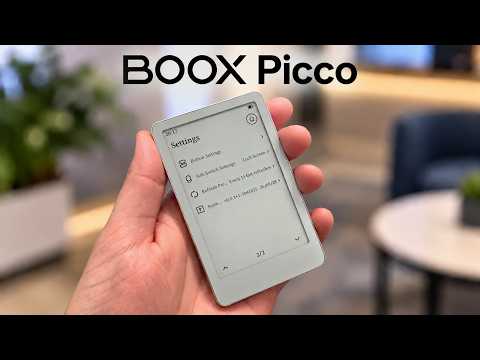
Watch: BOOX Picco: The Smallest BOOX Yet Has Some Surprises.
Video: TechAvid on YouTube
Compact Hardware: Display, Build, and Physical Controls
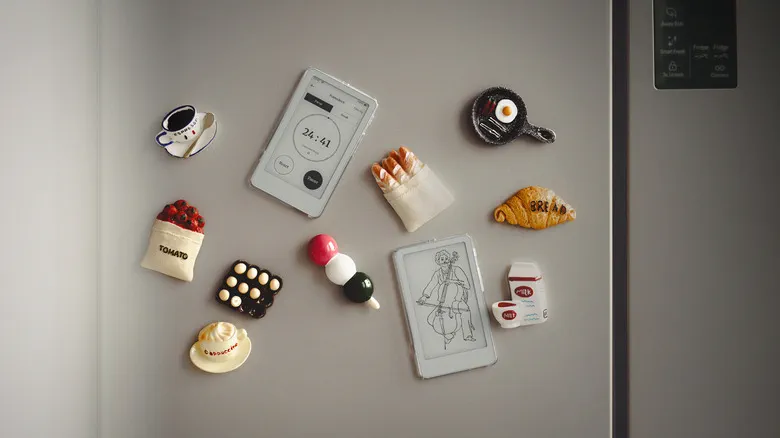 Photo: Engadget - Technology News & Expert Reviews (source)
At first glance, the Picco looks less like a conventional gadget and more like a sleek deck of playing cards. It measures just 105.5 x 62 x 5.5 mm and weighs a mere 58 grams (roughly 2 ounces). That featherweight build makes it significantly lighter than any modern smartphone or standard Kindle.
Despite the tiny footprint, Boox did not cut corners on essential reading hardware:
- Display: A 3.97-inch monochrome e-paper screen with a resolution of 480 x 800 pixels, delivering a sharp text density of 235 PPI.
- Lighting: Dual-tone front lighting with Color Temperature Management (CTM), allowing users to blend cool and warm LEDs for daylight or nighttime reading.
- Navigation: A hybrid control scheme featuring both a responsive touchscreen and physical side buttons for tactile page-turning.
- Orientation: Full four-way software screen rotation to accommodate left-handed or right-handed grips.
- Connectivity and Power: Equipped with a 920 mAh battery, a USB-C port for charging and wired transfers, 2.4 GHz Wi-Fi, and Bluetooth.
- Storage: A 16 GB microSD card comes pre-installed in the box, and the slot supports expansion up to 2 TB, giving users enough room for hundreds of thousands of standard EPUB titles.
Software and Reading Formats: Goodbye Android Bloat
Perhaps the biggest surprise for long-time Boox fans is that the Picco does not run full Android. Boox's popular Palma and Note lines rely on Android to run Google Play Store apps like Kindle, Kobo, and Libby. The Picco takes the opposite approach: it uses a streamlined, embedded operating system developed in collaboration with Crosspoint, built on an energy-efficient ESP32 architecture.
By dropping Android overhead, the device boots quickly, sips minimal standby battery, and avoids the background notifications and app management burdens of smart devices. However, this means there is no native DRM (Digital Rights Management) support. You cannot log directly into an Amazon Kindle account, open Adobe DRM library loans, or install the Libby app.
Instead, the Picco is strictly tailored for DRM-free personal book collections and public-domain literature. The Picco supports a comprehensive list of formats:
- Documents: EPUB, MOBI, AZW3, AZW, AZW5, FB2, FB2.ZIP, FB3, FBZ, TXT, PDB, PRC, RTF, HTML, XHTML, HTM, and CHM.
- Images: PNG, JPEG, WEBP, BMP, and GIF.
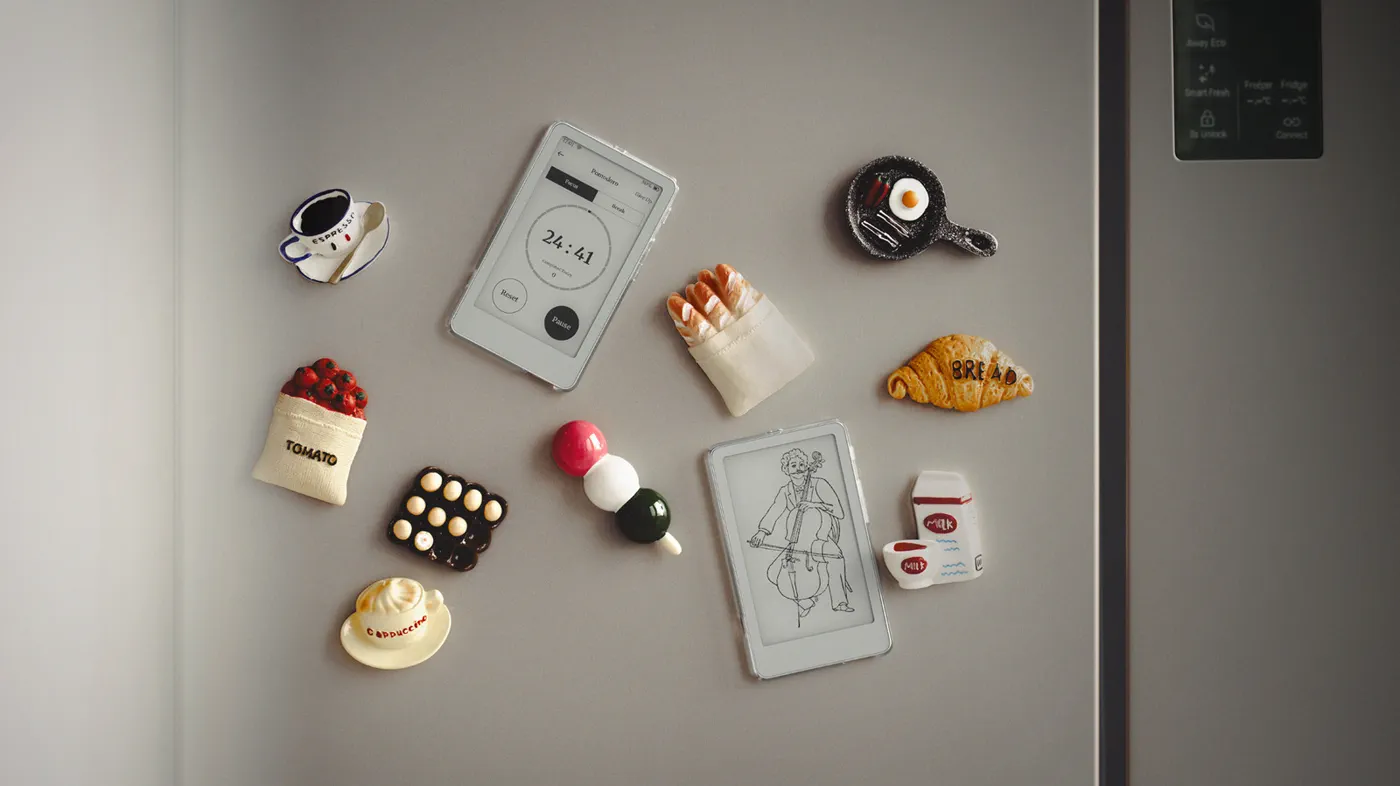
To move files onto the device, users can connect directly via USB-C, swap the microSD card, or use wireless local transfers via the companion BOOX Tiles mobile app or a web browser interface. Boox also pre-loads the device with a selection of classic public-domain literature and integrates a free web-based bookstore for open-access EPUB downloads. Embedded micro-tools include a Pomodoro productivity timer, a Todo list, a countdown utility, and a reading statistics dashboard.
The Phone-Mounted Reading Lifestyle: The Magnetic Ring Trick
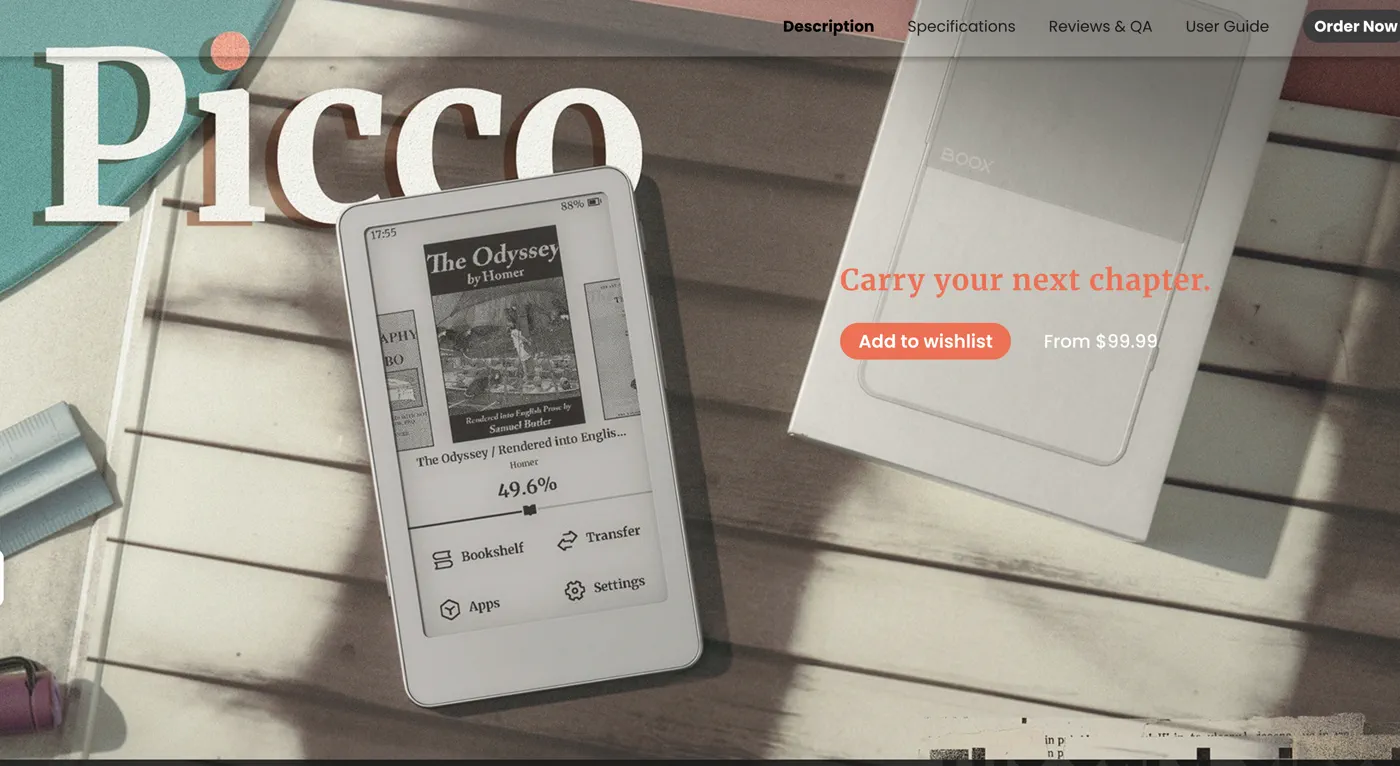 Photo: goodereader.com (source)
One of the most talked-about design choices of the Boox Picco is how Boox expects owners to carry it. Each Picco package includes a protective case integrated with an inner magnetic ring.
By taking advantage of magnetic phone backs (such as MagSafe-compatible iPhones or magnetic ring stickers on Android phones), the Picco can snap directly to the rear of your mobile phone. The concept targets habitual smartphone handling: when pulling your device out of your pocket or bag during an elevator ride or subway commute, you are presented with an e-ink page instead of a social feed, making it effortless to substitute deep reading for doomscrolling. Because the Picco is only 5.5 mm thin and weighs 58 grams, it adds negligible bulk when attached to an everyday carry setup.
The Tiny E-Reader Landscape: How Picco Compares
The pocket-sized e-paper category has exploded over the past year, transitioning from niche open-source DIY kits into commercial hardware. The Picco faces direct competition from boutique devices like the Xteink X4 series, as well as Boox's own premium handhelds.
| Feature | Boox Picco | Xteink X4 Pro | Boox Palma 2 | Amazon Kindle (Basic) |
|---|---|---|---|---|
| Display Size | 3.97 inches | 4.3 inches | 6.13 inches | 6.0 inches |
| Screen Type | Monochrome E Ink (235 PPI) | Monochrome E Ink (212 PPI) | Carta 1200 (300 PPI) | Carta 1200 (300 PPI) |
| Front Light | Warm & Cool (CTM) | Warm & Cool | Warm & Cool (CTM) | Cool only (4 LEDs) |
| Operating System | Lightweight Crosspoint OS | CrossPoint / Custom | Android (Google Play) | Kindle OS (Closed) |
| Navigation | Touch + Physical Buttons | Physical Buttons only | Touch + Physical Buttons | Touchscreen only |
| Weight | 58 g | ~68 g | 170 g | 158 g |
| Dimensions | 105.5 x 62 x 5.5 mm | 114 x 69 x 6.5 mm | 159 x 80 x 8.0 mm | 157.8 x 108.6 x 8.0 mm |
| Connectivity | Wi-Fi, Bluetooth, USB-C | Wi-Fi, Bluetooth, USB-C | Wi-Fi, BT, USB-C, GPS | Wi-Fi, USB-C |
| Storage | 16 GB included (up to 2 TB) | MicroSD expandable | 128 GB onboard | 16 GB onboard |
| Starting Price | $99.99 (preorder) | $99.00 | ~$279.99 | $109.99 |
Compared to the Xteink X4 Pro, the Picco offers a slightly more compact chassis, official touchscreen capability alongside physical page-turn buttons, and direct manufacturer support with OTA wireless firmware updates. Compared to the Boox Palma line, it trades app flexibility and Android versatility for a package that costs a third of the price and fits seamlessly in a shirt pocket.
The Path to 'Tiles': Why Boox Is Rethinking Form Factors
 Photo: prnewswire.com (source)
For years, the e-reader market remained stagnant around two archetypes: 6-inch entry-level book readers and large digital note-taking slates. Over the last two years, however, mobile form factors have gained serious traction among consumers suffering from digital eye strain and smartphone screen fatigue.
Boox initially tapped this wave with the Palma series, but its premium pricing and full Android architecture meant users still dealt with battery drain and notification clutter. Meanwhile, the hobbyist e-ink community rallied around custom ESP32 microcontrollers and the open-source CrossPoint firmware, proving that thousands of readers simply wanted a fast, lightweight reader that does one thing well.
By formally partnering with Crosspoint and launching the "Tiles" brand, Boox is validating that demand. It bridges the gap between grassroots open-source hardware projects and reliable commercial distribution, complete with warranty coverage and multi-region regulatory certifications.
Practical Buying Advice: Who Is the Picco Actually For?
Before jumping on the preorder, prospective buyers should assess their reading habits:
- You should buy the Boox Picco if: You maintain a personal library of DRM-free EPUBs or text files, love ultra-light everyday carry gear, read heavily during short daily commutes, and want a focused tool to curb habitual phone scrolling.
- You should skip the Boox Picco if: Your reading relies exclusively on borrowing books through the Libby/OverDrive ecosystem, you read graphics-heavy manga or complex PDF textbooks, or you require seamless syncing across the proprietary Amazon Kindle cloud. In those cases, a standard Kindle or an Android-based reader like the Boox Go 6 or Palma is a far safer investment.
What's Next: Shipments and Developer Interest
With preorders underway, Boox expects the first production batch to begin shipping globally by November 2026. Initial batches will include the device, pre-installed 16 GB card, three screen protectors, and the magnetic ring protective case in the box.
Beyond retail deliveries, tech enthusiasts are already watching to see how open the software environment remains. Given its Crosspoint platform lineage and ESP32 foundation, developers on forums like Reddit and GitHub are actively preparing custom forks, alternative reading apps, and personalized launcher skins. Whether as an out-of-the-box micro-reader or a tinkerer's e-paper canvas, the Picco marks a fresh direction for everyday portable reading.
FAQ
Can the Boox Picco run the Kindle or Libby apps?
No. The Boox Picco does not run Android or feature the Google Play Store, meaning it cannot natively install the Amazon Kindle, Kobo, or Libby apps. It is strictly designed to open non-DRM book formats like EPUB, MOBI, and AZW3 transferred directly by the user.
How do you transfer books to the Boox Picco?
You can load books using the included USB-C cable connected to a computer, via local Wi-Fi through the BOOX Tiles app or web browser, or by loading files onto the removable microSD card.
Does the Boox Picco have a front light for reading in the dark?
Yes. The 3.97-inch screen features built-in front lighting with both cool and warm temperature adjustments, allowing you to comfortably read in total darkness.
How does the magnetic attachment work?
The Picco includes a protective case equipped with an internal magnetic ring. This ring allows the e-reader to snap firmly onto MagSafe-compatible iPhones or phones with magnetic ring cases and adapters.
When will the Boox Picco ship, and what does it cost?
Preorders opened on September 28, 2026, on the official Boox online store at an introductory price of $99.99 (regular list price $109.99). Orders are scheduled to begin shipping by November 2026.