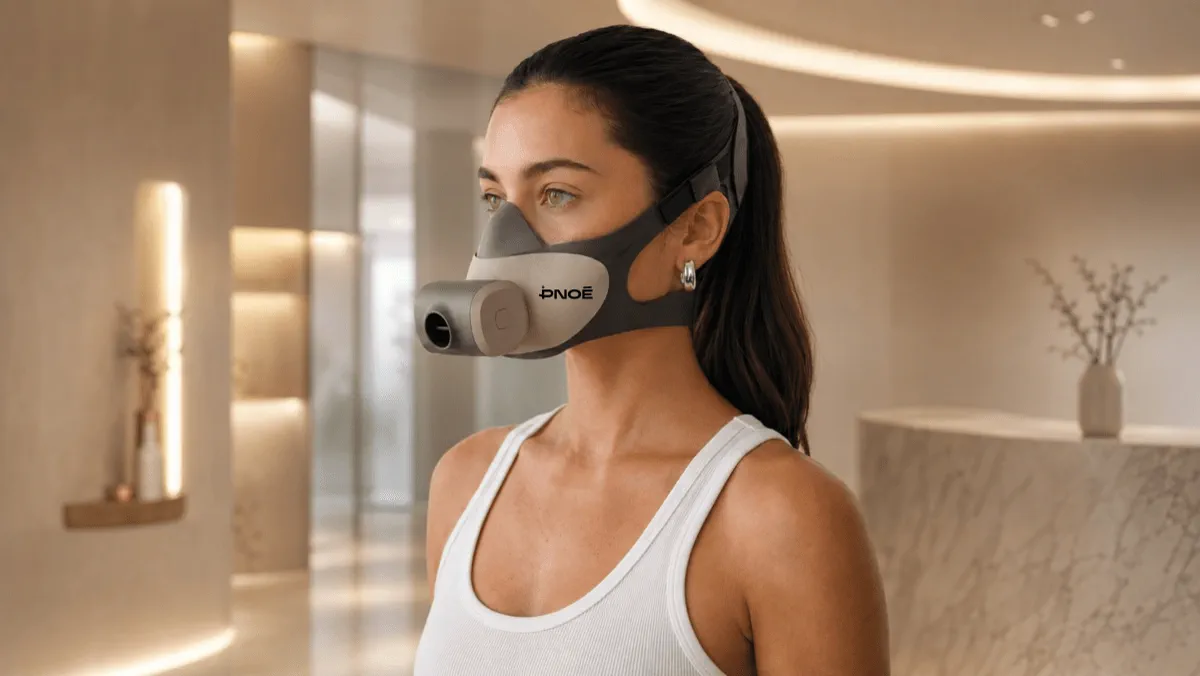
Malden, Massachusetts-based healthtech startup PNOĒ has officially unveiled a redesigned, self-serve version of its clinical-grade breath analysis mask, set to launch on October 1. The new device allows gym members and fitness enthusiasts to strap on the mask and complete an accurate VO₂ max and metabolic assessment in just 8 minutes without requiring a trained technician or exercise physiologist.
For years, getting a true metabolic read required scheduling an expensive appointment at an exercise physiology lab, medical center, or luxury wellness club, where a practitioner strapped a bulky, intimidating apparatus to your face and monitored every breath. By streamlining both the hardware and user guidance software, PNOĒ aims to turn metabolic profiling into an everyday amenity on standard gym floors, bridging the gap between hospital-grade diagnostic accuracy and consumer convenience.
The Announcement: Lab-Grade Breath Analysis Goes Self-Serve
PNOĒ's upcoming launch marks a major shift in how indirect calorimetry is deployed outside clinical walls. The company's original system established a footprint in elite sports and high-end fitness clubs, but it relied heavily on a certified operator to fit the mask, calibrate the sensors, run treadmill or cycle ergometer protocols, and interpret the data.
Beginning October 1, PNOĒ is rolling out a redesigned mask that shifts that workload to automated software and guided on-screen cues. The refreshed mask is substantially sleeker and less cumbersome than its predecessor, ditching the heavy industrial styling that earned the original unit comparisons to Batman's nemesis Bane in pop-culture reviews. Most importantly, the testing protocol has been condensed to 8 minutes, guiding the user autonomously through warm-up, ramp-up exertion, and recovery while capturing breath-by-breath gas exchange.
Under the Hood: Hardware Specs and the 23 Measured Biomarkers
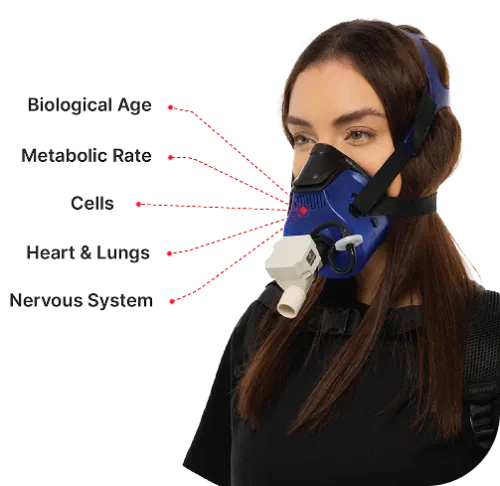 Photo: pnoe.com (source)
Unlike optical wrist monitors that infer oxygen efficiency using predictive mathematical algorithms, PNOĒ's device physically captures and analyzes expired gases. The mask houses precision micro-sensors that measure oxygen uptake ($VO_2$) and carbon dioxide output ($VCO_2$) breath by breath.
By continuously computing the respiratory exchange ratio (RER) alongside ventilation rate and airflow volume, the hardware extracts 23 distinct metabolic, cardiovascular, and respiratory biomarkers, including:
- Cardiorespiratory Metrics: Peak VO₂ max, aerobic threshold (VT1), anaerobic threshold (VT2), and peak minute ventilation.
- Metabolic Efficiency: Resting metabolic rate (RMR), active metabolic burn, and real-time fat versus carbohydrate oxidation ratios.
- Breathing Mechanics: Peak tidal volume (VT Peak), ventilatory efficiency ($VE/VCO_2$), and respiratory compensation points.
- Longevity Indicators: Calculated biological age derived from cardiopulmonary efficiency relative to clinical age-graded norms.
To operate without staff, the hardware features integrated connectivity that pairs directly to a gym kiosk, tablet, or smartphone. An adaptive interface instructs the user on how to check for an airtight seal, perform an automated zero-point calibration, and step through the physical exercise protocol.
| Feature | Traditional Lab CPET Carts | Original PNOĒ System | New PNOĒ Self-Serve Mask |
|---|---|---|---|
| Primary Setting | Hospital labs, universities | Boutique clinics, sports teams | Commercial gym floors, clinics |
| Operator Needed | Licensed exercise physiologist | Trained trainer or clinician | None (fully autonomous/self-serve) |
| Test Duration | 30 to 45 minutes | 12 to 20 minutes | 8 minutes |
| Hardware Form | Large wheeled cart, umbilical hoses | Portable backpack/chest pack | Sleek standalone mask system |
| Aesthetic Profile | Clinical / medical | Bulky "Bane-style" harness | Streamlined, lightweight consumer look |
| Direct Biomarkers | Comprehensive metabolic profile | 23 biomarkers | 23 biomarkers |
| Availability | Commercial diagnostic vendors | Active since 2018–2019 | Launches October 1 |
Background: How PNOĒ Reached the Gym Floor
PNOĒ was founded in 2016 by Greek engineers Apostolos Atsalakis and Panos Papadiamantis. Atsalakis began exploring portable indirect calorimetry during his graduate research at the University of Cambridge, identifying a persistent problem in healthcare: breath analysis was widely considered the clinical gold standard for assessing cardiopulmonary risk and metabolic rate, yet the equipment was trapped in academic institutions due to cost and technical complexity.
After joining Y Combinator's Winter 2019 cohort, the company launched its first portable analyzer, establishing dual operations in Palo Alto and Malden, Massachusetts, alongside engineering teams in Athens. Over the ensuing five years, PNOĒ gathered validation from academic institutions such as Rutgers University and Georgetown University, proving its portable sensors could rival standard stationary CPET systems like COSMED.
However, commercial gym operators faced an operational bottleneck. While luxury fitness brands like Equinox and performance wellness centers adopted the original device, offering tests required blocking out 45 to 60 minutes of a certified trainer's schedule to prep the mask, run the athlete on a treadmill, sanitize parts, and generate reports. The self-serve redesign is engineered specifically to eliminate that payroll hurdle.
The Longevity Wave and the Trouble with Smartwatch Estimates
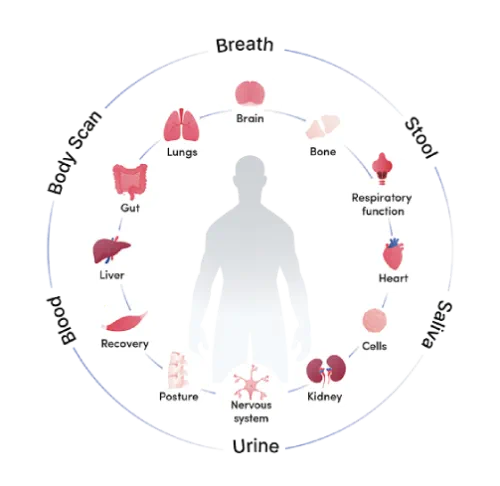 Photo: pnoe.com (source)
PNOĒ's push comes at a time when consumer obsession with VO₂ max is at an all-time high. Propelled by longevity advocates and clinicians like Dr. Peter Attia, VO₂ max is now widely recognized by the public as one of the single most reliable predictors of all-cause mortality and functional healthspan.
Millions of consumers look at VO₂ max scores daily on an Apple Watch, Garmin, or Whoop strap. Yet those wearables do not actually analyze expired gases. Instead, they use heart rate readings, GPS pace, age, and accelerometer data to estimate aerobic capacity. Studies and athletic testing routinely show smartwatch estimates can deviate significantly—frequently misreporting active calorie expenditure or VO₂ max by 10% to 20% or more depending on individual running efficiency, cardiac medication, or terrain.
By condensing direct spirometry and gas analysis into an autonomous 8-minute session, PNOĒ offers everyday fitness enthusiasts access to actual physical gas exchange data rather than statistical guesswork.
How the 8-Minute Protocol Works in Practice
When a gym-goer approaches a PNOĒ-equipped station—such as a dedicated stationary bike or treadmill—the testing sequence follows a structured workflow:
- Sanitization and Fitting: The user selects a sanitized, personal, or fresh modular silicone seal, attaches the central analyzer module, and fastens the straps. The software checks pressure levels to verify that ambient air is not leaking around the nose bridge or chin.
- Calibration: The device automatically runs a rapid ambient air calibration cycle to zero its oxygen and carbon dioxide sensors.
- Guided Ramp Test: The user begins pedaling or running. The on-screen interface dictates target cadence, speed, or resistance across distinct incremental stages.
- Data Crunching and Delivery: Over the course of the 8 minutes, the system measures baseline breathing, ventilatory transitions (the shift from predominantly fat burning to carbohydrate burning), and peak oxygen uptake at maximum exertion.
- Instant Results: The results sync straight to the user's mobile app, outputting exact cardiovascular training heart-rate zones, basal metabolic caloric requirements, and pulmonary efficiency markers.
Practical Advice: What Buyers and Facility Operators Need to Know
 Photo: pnoe.com (source)
For gym owners, corporate wellness directors, and boutique studio managers, the self-serve model transforms metabolic testing from a labor-intensive specialized service into an automated amenity or recurring revenue line. Previous full-service PNOĒ tests generally cost consumers between $150 and $450 at medical spas or private facilities. By removing the operator, clubs can bundle quarterly metabolic scans into standard premium memberships or offer them as lower-cost add-ons.
For end consumers preparing to use a self-serve station, standard metabolic prep rules remain vital for clean data:
- Fasting Window: Fast from food and sugary beverages for at least 3 to 4 hours prior to testing so acute digestion does not skew substrate utilization (fat vs. carb burn).
- Caffeine & Stimulants: Avoid pre-workout supplements and coffee for at least 6 to 12 hours, as artificial elevation of heart rate distorts ventilatory threshold calculations.
- Fit and Exertion: Ensure facial hair or loose headgear does not break the mask's seal, and be prepared to push to true near-maximal exertion during the final minutes to establish genuine peak $VO_2$.
Unanswered Questions and Next Steps
While an autonomous breath-testing kiosk represents a significant technical feat, several real-world hurdles remain. Chief among them is commercial hygiene: facilities will need foolproof sterilization protocols or affordable single-user modular facepieces to ensure members are comfortable breathing heavily into shared gear.
Second, user compliance during maximal exertion is notoriously unpredictable without an encouraging coach nearby. True VO₂ max testing requires pushing through significant muscular discomfort; an automated app must prove it can motivate unassisted gym members to reach genuine exhaustion safely without quitting prematurely. PNOĒ begins deploying the hardware to partner locations on October 1, when real-world data on consumer adoption and kiosk reliability will start rolling in.
FAQ
What does the new PNOĒ mask measure?
The system uses indirect calorimetry to measure inhaled oxygen and exhaled carbon dioxide, determining VO₂ max, resting and active metabolic burn rates, fuel utilization (fat vs. carbs), breathing efficiency, and biological age across 23 biomarkers.
How is this different from the previous PNOĒ device?
The original unit required an exercise physiologist or trained trainer to set up the equipment and supervise a 15- to 45-minute appointment. The new model features a sleeker, lighter physical design and an automated 8-minute protocol that gym members can complete on their own.
When does the self-serve PNOĒ mask become available?
PNOĒ begins launching the self-serve mask system on October 1 across partner gyms, longevity facilities, and wellness centers.
Why use a breath mask if smartwatches already calculate VO₂ max?
Smartwatches do not measure breath; they merely predict aerobic capacity using heart rate and movement algorithms, which often suffer from a 10% to 20% margin of error. PNOĒ directly analyzes gas exchange at the mouth, providing clinical-grade accuracy.
How often should someone perform a metabolic test?
Most exercise scientists and metabolic specialists recommend retesting every 6 to 12 weeks to measure physiological adaptations, update target heart rate training zones, and track longevity markers.