
Google's screenless health tracker, the $99.99 Fitbit Air, offers fitness enthusiasts an unobtrusive, lightweight way to monitor vital health metrics without constant notification buzzes. If you plan on tracking laps in the pool or taking it to the beach, you might wonder whether the wearable is truly waterproof. In short: no wearable device is completely waterproof, but the Google Fitbit Air is water-resistant up to 50 meters (5 ATM), meaning you can dive into the pool and swim with it without destroying your hardware.
However, there is a substantial difference between laboratory water ratings and real-world liquid exposure. From high-velocity water sports to hot showers and soapy lather, navigating where the device can and cannot go requires understanding how Google engineered this screen-free pebble. Here is everything you need to know about taking the Fitbit Air into the water.
Waterproof vs. Water-Resistant: The 5 ATM Reality
Consumer electronics manufacturers intentionally avoid using the term "waterproof" because no consumer gadget forms an impenetrable, permanent barrier against liquids. Instead, Google officially rates the Fitbit Air as water-resistant to 50 meters, conforming to the international ISO standard 22810:2010 rating of 5 ATM.
Under this standardized testing framework, the device withstands static hydrostatic pressure equivalent to being submerged under 50 meters (roughly 164 feet) of motionless water. In real-world terms, static pressure is not the same as active motion. Moving your arm vigorously through water creates dynamic pressure spikes that exceed standard immersion forces. That is why a 5 ATM device is rated for shallow surface swimming, recreational water immersion, and heavy perspiration, but is distinctly unsafe for scuba diving, cliff jumping, or deep submersions.
Google also includes standard engineering disclosures in the device's documentation: water resistance is not a permanent state. Over the lifespan of the gadget, normal wear and tear, drops, micro-fractures, and aging rubber gaskets will steadily degrade its seal.
Watch: Google Fitbit Air – 30 Days Later: An Honest Review

Video: Andrew Ethan Zeng on YouTube
Hardware, Dimensions, and Water Specs
 Photo: Engadget - Technology News & Expert Reviews (source)
The Google Fitbit Air is built around a compact, screen-free pod that docks into interchangeable straps. The core hardware contains an optical heart rate monitor, 3-axis accelerometer, gyroscope, red and infrared SpO2 sensors, and a device skin temperature sensor.
Because the hardware unit lacks a touchscreen, physical mechanical buttons, or external speaker grilles, it presents fewer penetration points for water ingress than full-featured smartwatches. The charging connection relies on bi-directional magnetic contacts situated flush against the recycled polycarbonate shell.
| Specification | Google Fitbit Air Details |
|---|---|
| Starting Price | $99.99 (Standard) / $129.99 (Special Edition) |
| Water Resistance Rating | 5 ATM / 50 meters (ISO 22810:2010) |
| Weight | 5.2 g (sensor only) / 12 g (with standard band) |
| Dimensions | 34.9 x 17 x 8.3 mm |
| Casing Material | Recycled polycarbonate and PBT plastics |
| Sensors | Optical HR, 3-axis accelerometer, gyro, SpO2, skin temperature |
| Battery Life | Up to 7 days; 5-minute charge yields 1 day |
| Display | None (Screenless form factor) |
| Companion Software | Google Health app (3 free months of Premium) |
Swimming and Water Sports: What You Can Actually Do
If you are an active swimmer, the Fitbit Air is designed to accompany you during routine pool training. Because the tracker syncs with the revamped Google Health app, it automatically detects swimming workouts using its internal motion sensors and logs duration, estimated calorie burn, and cardiovascular output.
Here is how common water activities stack up against the Fitbit Air's protective tolerances:
- Lap Swimming (Pool): Fully supported. The tracker handles standard pool depths and chlorine without issue, provided it is rinsed with tap water after your session.
- Ocean Swimming and Snorkeling: Supported with caution. Salt water will not immediately destroy the casing, but salt crystals cause rapid corrosion to magnetic charging pins and gaskets if allowed to dry. Immediate freshwater rinsing is mandatory.
- High-Speed Water Sports: Prohibited. Activities like water skiing, wakeboarding, jet skiing, surfing, or diving involve forceful water impact that can overwhelm the seals.
- Scuba Diving: Prohibited. The Fitbit Air is strictly rated for shallow water and cannot survive the sustained ambient pressures of recreational scuba diving.
Unlike smartwatches that require a manual "water lock" to disable touch interfaces from misregistering phantom taps in the water, the Fitbit Air's completely faceless design means you never have to worry about swimming strokes messing with an on-wrist display.
The Shower and Sauna Trap: Why Heat and Soap Break Seals
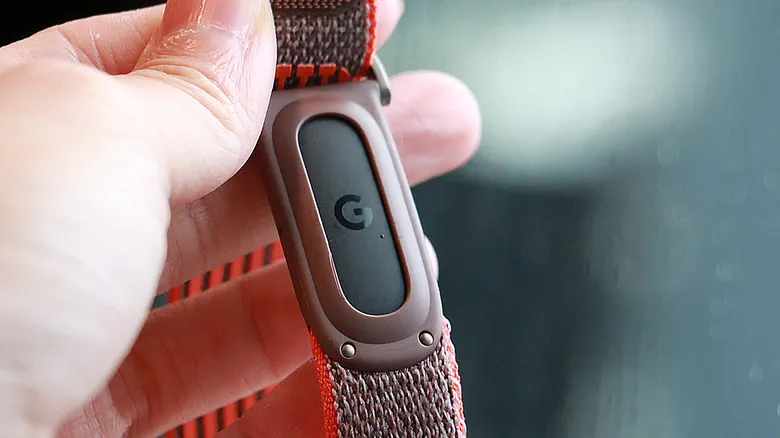 Photo: Engadget - Technology News & Expert Reviews (source)
A common mistake wearable owners make is assuming that because a tracker survives a 50-meter lap pool, it can easily survive daily showers. In fact, Google's documentation and wearable specialists consistently advise removing the Fitbit Air before stepping into the shower.
The danger in the bathroom does not stem from water volume; it stems from temperature and chemistry. Hot water from showers, saunas, and steam rooms causes the tracker's plastic housing and rubber sealing membranes to expand and soften at uneven rates. Over time, this thermal cycling creates microscopic gaps in the waterproof seal.
Furthermore, surfactants present in soaps, shampoos, body washes, and conditioners dramatically lower the surface tension of water. This allows moisture to seep past internal barriers that would easily repel pure water. Soaps also leave a chemical residue that clogs sensor windows and breaks down external elastomer coatings.
Band Materials and the Stephen Curry Edition Confusion
When Google unveiled the Fitbit Air alongside its $129.99 Stephen Curry Special Edition, fine print regarding water resistance sparked confusion among early buyers. Google's store noted that a "protective water-resistant coating may diminish or be completely removed over time due to normal wear and tear".
Some potential buyers worried that the device's internal water resistance was merely a surface spray. However, technical teardowns and product specifications clarify that this disclaimer applies specifically to the textile band, not the core tracker pod. The silicone Active Band is entirely sweatproof and hydrophobic. The Stephen Curry model features a specialized woven Performance Loop treated with a water-repellent coating designed to speed drying and resist sweat absorption during heavy cardio.
If you swim regularly, pairing the Air with a silicone Active Band is strongly recommended. Fabric straps will absorb pool water, stay damp against the skin for hours, and promote contact dermatitis if not removed and thoroughly air-dried. Leather, metal mesh, and dressier modern bracelet accessories should never be worn while swimming.
How Fitbit Air Compares to Rivals
 Photo: Engadget - Technology News & Expert Reviews (source)
The screenless fitness tracker segment has expanded rapidly, placing the Fitbit Air in direct competition with screen-free wearables like Whoop, as well as Google's own screened portfolio.
| Device | Form Factor | Water Rating | Best Use Case |
|---|---|---|---|
| Google Fitbit Air | Screenless puck | 5 ATM (50m) | Casual swimmers, everyday health tracking |
| Whoop 4.0 / 5.0 | Screenless band | IP68 / 10m | Athletic recovery, continuous wear |
| Google Fitbit Edge | Screened band | 5 ATM (50m) | Runners needing live pacing and lap counters |
| Google Pixel Watch 3 | Full Smartwatch | 5 ATM (50m) | Wear OS users wanting on-wrist apps |
The Fitbit Air matches or exceeds the water protection of its primary screenless rival, Whoop, which is typically certified to an IP68 standard at shallower depths. However, smartwatches with displays like the Fitbit Edge or Pixel Watch 3 give swimmers real-time glanceable feedback on split times and heart rate zones mid-lap—something the screenless Air delegates entirely to post-swim reviews in your smartphone app.
Proper Post-Swim Care and Maintenance
To ensure your Google Fitbit Air maintains its water resistance and continues measuring biometric signals accurately, follow these routine maintenance habits after any aquatic workout:
- Rinse with fresh water: Whenever you exit a chlorinated pool, brackish lake, or saltwater ocean, thoroughly rinse the sensor pod and band under gentle tap water to wash away corrosive minerals.
- Dry completely: Wipe the plastic housing, optical sensor array, and charging contacts dry using a soft, lint-free microfiber cloth. Never blast the device with a hot hair dryer, as excess heat can deform the seals.
- Take it off: Clean and dry your wrist before strapping the device back on. Trapping moisture between the tracker and your skin for extended periods can trigger rashes or irritation.
- Inspect after drops: If you drop your Fitbit Air onto concrete or tiles, inspect the casing carefully. Hard impacts can crack plastic seams or displace gaskets, terminating water resistance without warning.
FAQ
Can I wear the Google Fitbit Air in the shower?
While the Fitbit Air can survive incidental shower splashes, Google advises taking it off. Soaps, shampoos, and warm water deteriorate the internal silicone seals and chemical coatings over time.
Does the Fitbit Air track swimming automatically?
Yes, the Fitbit Air uses its 3-axis accelerometer and gyroscope to automatically detect swimming activity and log metrics like duration and cardio impact in the Google Health app.
Can I swim in the ocean with the Fitbit Air?
Yes, you can wear the Fitbit Air in saltwater, but you must rinse it with clean tap water and dry it thoroughly immediately afterward to prevent salt buildup on the charging pins.
Does the Stephen Curry Edition have different waterproofing?
The core sensor puck has the exact same 5 ATM rating as the standard model. The Stephen Curry Edition simply adds a water-repellent coating to its fabric Performance Loop band to reduce moisture absorption.
What should I do if my Fitbit Air stops working after getting wet?
Immediately dry the device thoroughly, remove the band, and do not place it on its magnetic charger while damp. Contact Google Support to review warranty coverage, keeping in mind that liquid damage resulting from wear and tear is rarely covered under standard hardware warranties.