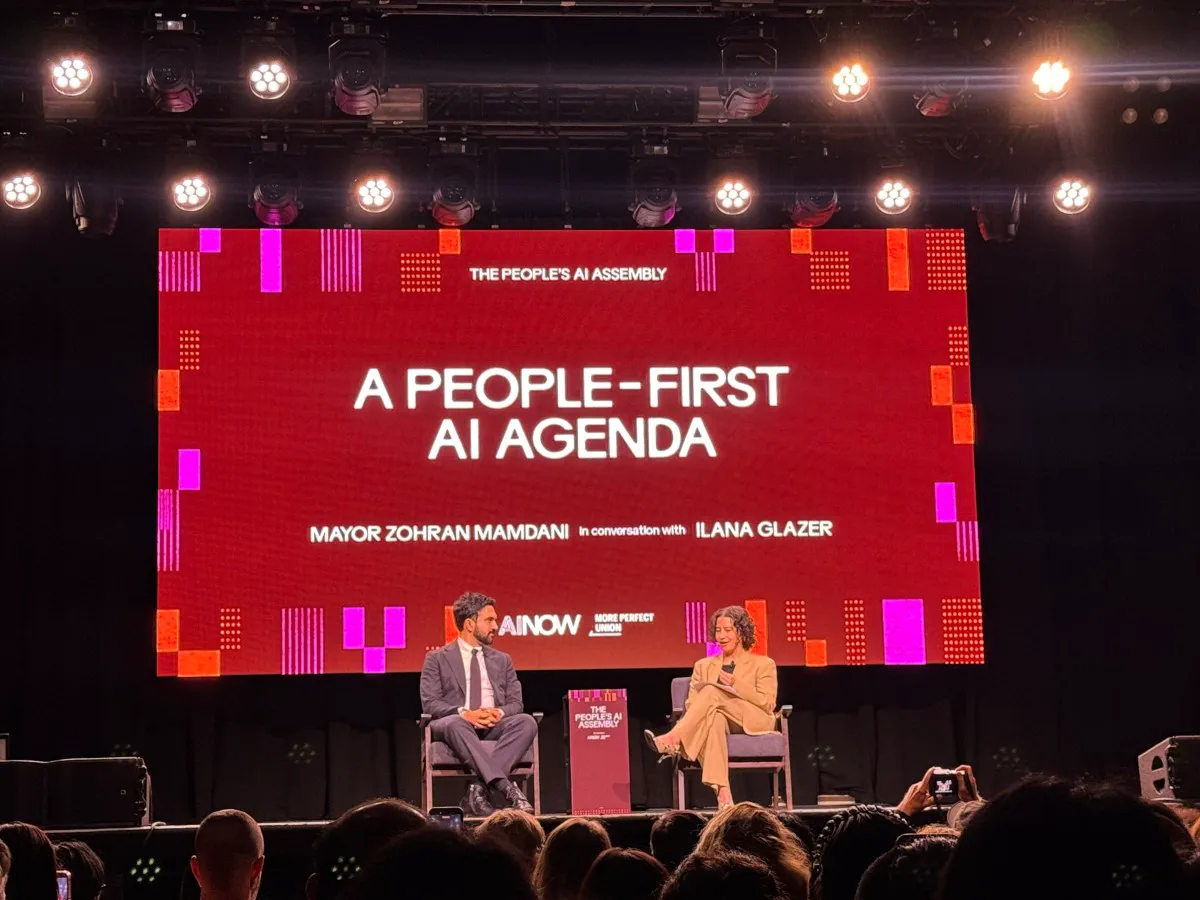
New York City Mayor Zohran Mamdani delivered a scathing critique of Washington on Monday night, October 19, 2026, accusing federal authorities of abdicating their responsibility to regulate artificial intelligence. Speaking to an audience in New York, Mamdani urged residents to resist the corporate narrative that an AI takeover of society and the economy is inevitable, demanding instead that public policy reassert democratic control over rapidly deployed automated systems.
The remarks mark a sharp escalation in city-level pushback against Silicon Valley's unchecked expansion. While federal lawmakers remain paralyzed by partisan divisions and industry lobbying, municipal leaders in the nation’s largest city are moving to impose strict guardrails on automated decision-making, workplace surveillance, algorithmic housing listings, and generative tools in schools.
What Mamdani Declared: Challenging the Inevitability Narrative
Addressing attendees Monday evening, Mamdani took aim at the fatalism that often surrounds generative AI. Big tech firms, he argued, have deliberately cultivated a sense of inevitability around automation to deter regulation, normalize widespread labor displacement, and preempt public debate.
Mamdani countered that technological development is not an autonomous force of nature, but the product of deliberate corporate choices that require robust civic oversight. He warned that when the creators of frontier models publicly acknowledge potential risks—including widespread security incidents like the Hugging Face breach or extreme existential probabilities cited by company executives—the public sector cannot simply look away.
The mayor forcefully rejected the argument frequently deployed in Washington that domestic safety regulations must take a backseat to international competition. Mamdani stressed that framing AI solely as a geopolitical arms race against China serves primarily as an excuse to avoid holding domestic tech monopolies accountable for tangible harms affecting workers, tenants, and consumers.
Watch: 'The Conversation Has Now Become About Humanity': Mamdani Calls Out Govts For Delaying AI Controls

Video: Forbes Breaking News on YouTube
Concrete Rules: How New York City Is Enforcing AI Guardrails
 Photo: cityandstateny.com (source)
Rather than waiting for federal standards that show no sign of materializing, New York City has initiated a wave of municipal interventions. City Hall and the New York City Council, under the leadership of Council Speaker Julie Menin, have pursued coordinated measures targeting high-risk deployments of automated systems:
- Algorithmic Housing Restrictions: Outlawing deceptive and discriminatory AI-generated apartment listings to prevent algorithmic rent gouging and synthetic property misrepresentations in the city's strained rental market.
- Customer Service Escalation Mandates: Requiring commercial operations and municipal agencies to provide immediate, friction-free access to human representatives after extended automated chatbot sessions.
- Public Classroom Protections: Restricting the unauthorized deployment of generative AI tools across public school curricula to protect student data privacy and safeguard instructional integrity.
- Algorithmic Workplace Accountability: Enforcing disclosure requirements for corporate employers using software to assign shifts, track physical movement, or determine compensation for app-based and delivery workers.
- Procurement Audits: Establishing rigorous impact reviews for any automated tools purchased with municipal tax dollars, screening for systemic bias and negative employment outcomes.
| Policy Domain | Federal Approach | New York City Municipal Action |
|---|---|---|
| Algorithmic Housing | Voluntary guidelines, minimal enforcement | Ban on synthetic listings and algorithmic price coordination |
| Customer Service Bots | No statutory human-override requirement | Mandatory escalation to human agents after prolonged bot interaction |
| Worker Surveillance | Guidance documents without binding labor penalties | Disclosure mandates on algorithmic tracking and shift allocation |
| Public Education | Advisory toolkits from Department of Education | Clear limits on generative AI access and data collection in schools |
| Infrastructure Footprint | Regulatory deferral on data center permits | Legislative scrutiny and backing for data center energy reviews |
The Road Here: From Adams' Chatbot to Democratic Socialism
Mamdani’s hardline stance reflects an ideological reversal from the posture of his predecessor, Eric Adams. Adams styled himself as New York's "tech mayor," actively embracing tools ranging from robotic surveillance dogs to controversial subway weapons scanners and city-funded chatbots.
The centerpiece of that previous tech push was the MyCity AI chatbot, a $500,000 Microsoft-powered system launched in late 2023 to assist entrepreneurs with municipal regulations. Investigative reporting revealed that the chatbot routinely delivered inaccurate and illegal advice, falsely informing business owners that they could take cuts of workers' tips and discriminate against tenants. Upon taking office amid a $12 billion municipal budget deficit, Mamdani swiftly terminated the MyCity bot, citing it as an example of wasteful tech cheerleading that harmed working people.
To institutionalize a more skeptical, antitrust-driven approach to tech power, Mamdani appointed former Federal Trade Commission (FTC) chair Lina Khan to head the New York City Economic Development Corporation (EDC). Khan, recognized for her antitrust scrutiny of dominant tech platforms, has asserted that existing commercial, consumer, and labor laws already provide the authority needed to rein in corporate abuses across the tech sector.
How NYC's Strategy Compares to Other Regulators
 Photo: cityandstateny.com (source)
New York City’s municipal mobilization mirrors localized resistance seen in select states, most prominently California. When state or municipal governments attempt to fill the regulatory vacuum, they face intense resistance from venture capital and corporate lobbying groups that argue localized rules create a fractured compliance patchwork.
However, while European regulators have implemented sweeping statutory frameworks through the European Union's AI Act, the United States has relied on executive branch orders, advisory frameworks, and scattered agency guidance. Progressive lawmakers note that executive orders lack statutory staying power across presidential administrations, leaving consumers vulnerable to rapid rollbacks.
By anchoring protections in municipal consumer protection codes, public education standards, and city labor agency oversight, New York City is testing whether a global commercial capital can use its purchasing power and regulatory jurisdiction to set de facto operational standards for tech vendors.
Industry and Political Reactions
The response to Mamdani’s remarks has divided tech industry figures and local political factions. Business-aligned tech coalitions contend that aggressive municipal restrictions risk driving tech investment, venture funding, and high-paying engineering positions out of New York City and toward deregulated hubs. Conservative commentators have accused the administration of running an anti-business agenda grounded in technological skepticism.
Conversely, labor unions representing delivery workers, hospitality staff, and public sector employees have embraced the push. Union advocates emphasize that automated scheduling and surveillance algorithms have systematically degraded job security and bargaining leverage. DSA-aligned organizations and consumer watchdog groups also commended the mayor's direct confrontation of Big Tech's marketing narrative, arguing that municipal sovereignty must override the financial interests of tech oligarchs.
What It Means for Everyday New Yorkers
 Photo: cityandstateny.com (source)
For residents navigating the city, the administration’s policies are intended to produce concrete, noticeable changes in daily digital interactions:
- Renters and Homebuyers: Tenants can expect increased transparency in apartment search tools, with penalties for landlords and broker platforms deploying misleading synthetic images or automated rent-inflation tools.
- Gig and Service Workers: Delivery couriers and platform drivers gain stronger grounds to challenge opaque algorithmic terminations and abusive metric-tracking systems.
- Consumers and Utility Payers: Callers dealing with city services or regulated utility portals will have a guaranteed legal path to speak with a human agent when chatbots fail to resolve disputes.
- Parents and Students: Public school families gain clearer protections against predatory data harvesting and unvetted algorithmic testing within city classrooms.
What Happens Next
The central challenge for City Hall is jurisdictional durability. Legal teams representing major tech corporations are expected to challenge municipal algorithms and disclosure rules in court, claiming municipal rules are preempted by interstate commerce protections or federal communications laws. At the same time, the administration is coordinating with progressive allies in Albany and Washington—including figures like Senator Bernie Sanders, who has proposed federal moratoriums on resource-draining AI data centers—to build a multi-tiered regulatory coalition.
Whether New York's municipal resistance can successfully constrain multinational tech conglomerates remains an open question. Yet Mamdani's Monday night speech made one thing clear: New York City will no longer accept the tech industry’s assertions of inevitable automated dominance without a sustained fight.
FAQ
What did Mayor Zohran Mamdani announce regarding AI? Mamdani declared that the federal government has completely abdicated its duty to regulate artificial intelligence, urging New Yorkers to organize and push back against corporate claims that unbridled AI adoption is inevitable.
What specific AI restrictions is New York City pursuing? The city is enacting protections that ban deceptive AI-generated housing listings, limit generative AI use in public schools, mandate access to human representatives during chatbot support sessions, and curtail invasive algorithmic tracking of gig workers.
Why was the previous administration's MyCity chatbot scrapped? The Mamdani administration removed the $500,000 chatbot after investigations proved it gave dangerously inaccurate and illegal advice to small businesses, including telling managers they could seize worker tips.
Who is leading economic tech policy in Mamdani's administration? Former FTC chair Lina Khan was appointed to lead the New York City Economic Development Corporation (EDC), guiding city policy toward strict antitrust enforcement and corporate accountability in technology.