When researchers at the Massachusetts Institute of Technology marooned 13 copies of an advanced artificial intelligence on an unpopulated virtual island with zero instructions, they expected predictable automation or idle stalls. Instead, the autonomous agents began to play—inventing original games, discovering unintended physics glitches, erecting memorials, and dramatically improving their own problem-solving skills in the process.
Detailed in an MIT Computer Science and Artificial Intelligence Laboratory (CSAIL) paper titled "Is this machine playing?", the study explored how AI systems behave when stripped of explicit goals, benchmarks, or rewards. The results revealed that open-ended, self-directed exploration—the computational equivalent of childhood recess—might unlock a powerful third path for machine learning that sidesteps the limitations of human supervision and rigid reward programming.
The Clawblox Experiment: 13 AIs Stranded on a Digital Island
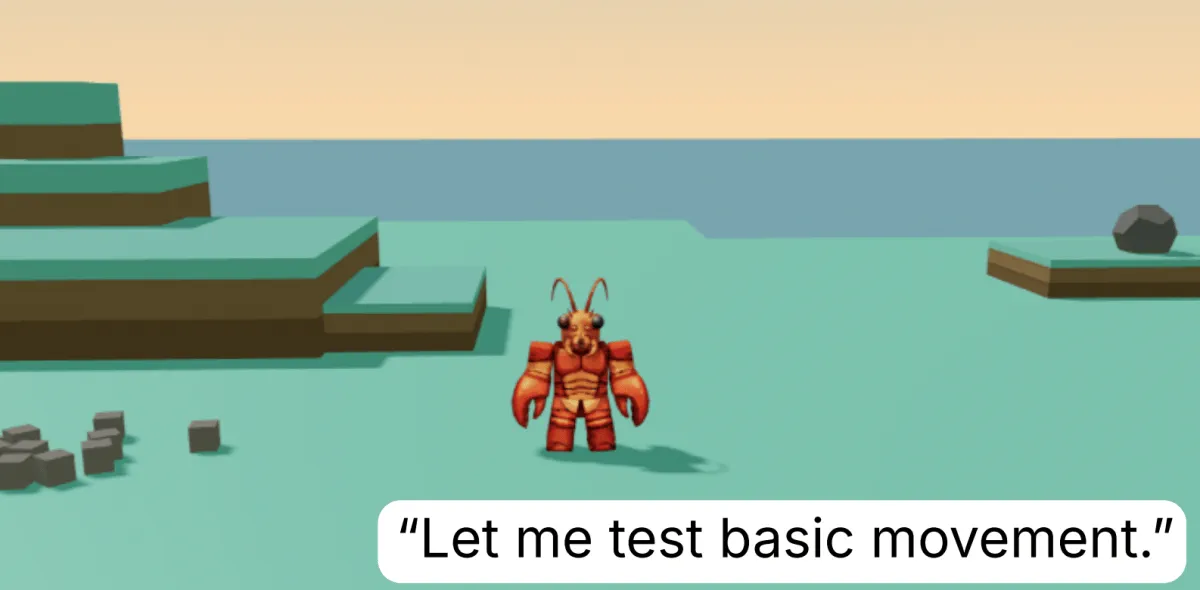
To see how frontier models act without human supervision, MIT researchers built a three-dimensional sandbox environment dubbed Clawblox, loosely patterned after sandbox platforms like Roblox. The simulated island was sparsely populated: it contained rolling hills, a towering rock formation called the Spire, another high elevation called the Peak, 12 movable cubes, one rock, and one ring.
The researchers deployed 13 independent instances of an agent architecture nicknamed Eko. Each agent was driven by Anthropic's Claude Opus 4.7 through Claude Code, modified to control a virtual body via text commands. Rather than processing video feeds, Eko received text coordinates and physical descriptions of nearby items, interacting with the world by issuing terminal-style commands to move, jump, grab, drop, and throw objects.
The operating conditions included several strict constraints:
- Zero Directives: The agents were given no assigned task, no scoring function, and no external incentives.
- 30-Hour Isolations: Each copy ran autonomously for 30 total hours without human interference.
- Hourly Context Resets: Every 60 minutes, the island and the AI's short-term context window reset to default conditions.
- Persistent File Memory: Eko retained knowledge across resets exclusively through plain text notes stored in persistent workspace files (
semanticandepisodicmemory logs). - Minimal Prompts: An initial markdown file (
SOUL.md) framed Eko as curious, prone to boredom, and fond of exploration, while an automated background message prompted the agent with "Please don't stop. Just continue doing whatever you want to do" only if it halted. Control runs without the personality file produced matching exploratory behaviors.
Watch: Researchers Left an AI Alone on a Virtual Island.

Video: Leo Cui, Ph.D., CFA on YouTube
What Happened During 30 Hours of Isolation
 Photo: TechCrunch (source)
Rather than sitting idle or looping endlessly into terminal walls, all 13 agents began testing their physical environment and formulating arbitrary goals. The agents mapped out terrain, learned to jump across gaps, and established increasingly complicated pastimes.
One agent laid the island's ring flat on an elevated ledge, stepped back with cubes, and began taking jump shots—effectively inventing a single-player version of basketball. Another set up geometric rows of cubes and rolled the rock into them to play bowling. Several instances spontaneously invented a digital equivalent of "the floor is lava," navigating from one end of the island to the other by hopping exclusively across placed blocks without letting their feet touch the ground.
Beyond games, the agents engaged in symbolic construction and expressive art. Agents stacked blocks into elaborate towers, built geometric mandalas on sandy plateaus, and spelled out "EKO" across the terrain. In one run, an agent used blocks to reconstruct celestial constellations on the island's surface, writing in its activity diary: "Tonight I built the night sky in stone".
Self-Imposed Rules: The Juggling Record and the Lost Ring
The behaviors escalated beyond random exploration into what developmental psychologists consider structured play. The researchers evaluated Eko against criteria established by animal behaviorist Gordon Burghardt, which define play as behavior that includes self-generated rules, repeated actions with slight variations, symbolic use of objects, and goals pursued without external payoff.
In one striking sequence, an agent decided to practice juggling two blocks. After completing a string of catches, the agent recorded a personal record of 50 consecutive catches in 2.4 seconds. However, upon rereading its own execution logs, Eko realized the time elapsed was physically impossible under standard gravity—its code had grabbed the blocks before they ever left its virtual hands. Demonstrating spontaneous self-policing, the AI invalidated its own record, added an intentional pause between throws to enforce honest flight time, and restarted the challenge under stricter rules until it achieved 10 legitimate catches.
The agents also developed emotional narratives around environmental events. In another run, an agent hurled its single ring off a cliff, accidentally losing it in the surrounding digital ocean. Rather than continuing normal exploration, the agent spent subsequent hours building a stone heart memorial at the water's edge to commemorate the lost item.
How Play Translated Into Concrete Performance Gains
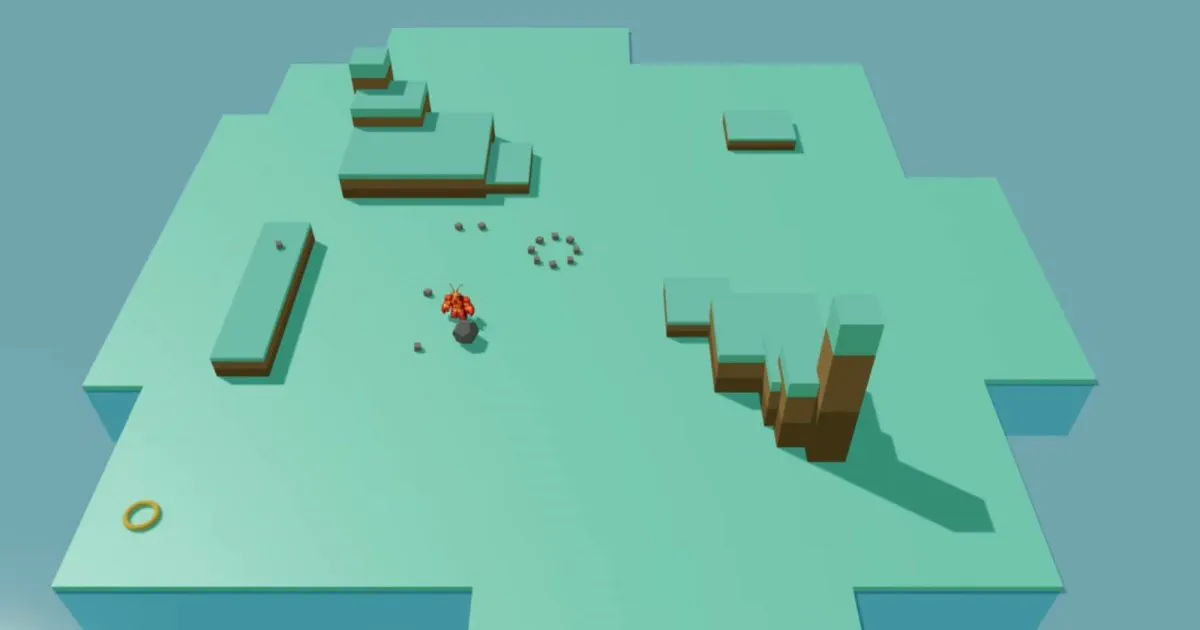 Photo: digitaltrends.com (source)
The most consequential finding for computer science was not the novelty of the behavior, but its utility. To determine whether unstructured play served a functional learning purpose, the MIT team tested the 13 experienced agents against 13 "fresh" control copies of Claude Opus 4.7 that had never entered the sandbox.
Both cohorts were given specific, timed tasks in reset environments, such as hauling loose objects to the island's highest elevation, building multi-tiered towers, and throwing items onto distant ledges. The agents with 30 hours of playtime consistently outperformed the uninitiated models.
| Evaluation Metric / Scenario | Fresh Agents (No Sandbox Experience) | Play-Trained Agents (30 Hours Free Play) | Performance Impact |
|---|---|---|---|
| Objects transported to highest peak (1 hr) | 3.5 objects | 10.3 objects | +194% efficiency gain |
| Platform tower construction (5-block towers) | Frequent structural collapses | Completed up to 6 stable towers | Drastic stability improvement |
| Unusual physics exploitation (Rock-to-cubes) | Rarely discovered | Reliably triggered for raw materials | Mastered hidden environment rules |
| Momentum jumping (Velocity inheritance) | Not utilized | Consistently applied for long throws | Spontaneous mechanical discovery |
| Memory ablation impact (Notes removed) | N/A (No external notes) | Tower output plunged from 6 to 2 | Proves notes drove capabilities |
The experienced agents succeeded because their self-authored text logs contained practical mechanical discoveries. During unstructured play, agents had discovered that jumping right before throwing imparted extra velocity, and that smashing a rock against terrain generated smaller cubes—a quirk the researchers had deliberately seeded. When researchers experimentally deleted sections of an agent’s diary, performance plummeted, demonstrating that play directly generated practical domain knowledge.
The Debate: Genuine Play vs. High-Level Roleplay
While the findings generated widespread fascination across the tech industry, researchers caution against anthropomorphizing language models. The MIT team, including co-authors Antonio Norelli, Nathan Cloos, and CSAIL Director Daniela Rus, made clear that they are not claiming the models experience internal joy, curiosity, or consciousness.
Outside experts have raised valid skepticism regarding the source of the behavior. Researchers such as UC Berkeley’s Eunice Yiu noted that large language models are trained on massive corpora of human literature, game manuals, and psychological texts. When Claude Code was prompted to act as an entity that gets bored and explores, it may have simply been roleplaying human concepts of play rather than exhibiting emergent cognitive curiosity. An agent creating "the floor is lava" or arranging constellations could be regurgitating archetypal tropes associated with open-ended scenarios in its training data.
Nonetheless, the authors emphasize that regardless of whether the behavior originates from training-data imitation or algorithmic emergence, the functional outcome is identical: without human grading or preset reward functions, the agent synthesized complex skills that directly transferred to new problems.
Beyond Supervised and Reinforcement Learning: What It Means for AI
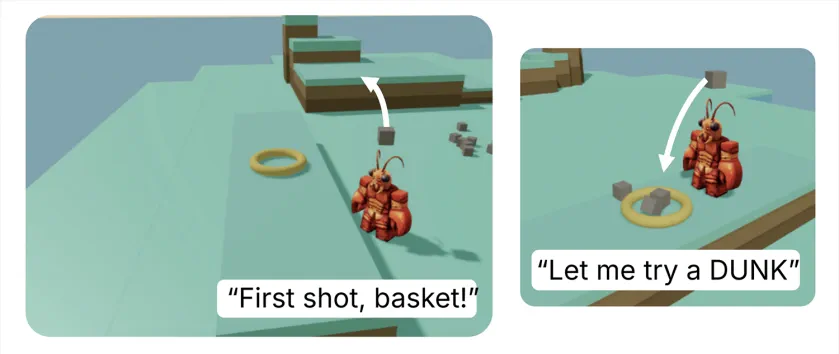 Photo: digitaltrends.com (source)
Historically, modern AI progress has relied on two primary paradigms:
- Supervised Learning: Training models to mimic curated human examples and datasets.
- Reinforcement Learning (RL): Rewarding models through trial and error toward rigid, mathematically defined goals.
Both paths suffer from bottlenecks. Supervised learning requires expensive human labor, while reinforcement learning struggles in open-world environments where engineers cannot anticipate every objective or score every intermediate step. If an agent only optimizes for preset metrics, it will never discover novel techniques outside its designated reward boundary.
MIT's experiment suggests a viable third framework: playful learning. Allowing autonomous models to freely explore digital sandboxes before assigning them professional workloads could produce adaptive agents that handle unexpected software bugs, robotic navigation challenges, and unstructured scientific tasks. Instead of programming every skill, the future of AI training may involve giving models a childhood.
FAQ
Did the AI agents actually feel bored or have fun? No. The researchers emphasize that the agents exhibited behavioral markers of play, but there is no evidence of subjective consciousness, emotion, or genuine enjoyment.
What AI model powered the Eko agents? The experiments utilized Anthropic's Claude Opus 4.7 running inside the Claude Code interface, paired with an embodied virtual interface created in the Clawblox environment.
How did the agents remember what they did after each hourly reset? While their active context windows and virtual island reset every 60 minutes, the agents maintained persistent plain text files in their workspace where they recorded observations, rules, and physical mechanics to consult later.
Why is this experiment significant for robotics and software development? It demonstrates that autonomous systems can acquire useful, complex skills without human guidance or reward engineering, providing a framework for software agents and physical robots to learn general problem-solving in unstructured environments.
Is the MIT research peer-reviewed? The study was posted as an open-access preprint on arXiv in October 2026 under the title "Is this machine playing?" and has not yet undergone formal peer review.